Share

Darevsky’s Viper
🔤 Taxonomy
Vipera darevskii, Darevsky’s viper, belongs to the small shield-headed vipers of the Lesser Caucasus. Publications also use Pelias darevskii. The current database includes the Turkish forms kumlutasi, olguni and uzumorum as subspecies; preserve these locality identities instead of mixing breeding lines.
📌 Description
A small, patterned highland viper, usually within an approximate 25–45 cm planning range. The grey or brown back carries a darker zigzag. Its main management problem is summer overheating: a small body and short mountain activity season do not make it suitable for a warm household or inexperienced keeper.
The numbers below are provisional management starting points, inferred from habitat and comparative viper care, not measured species optima or safe limits. Enclosure dimensions are a practical recommendation. Species-specific longevity is insufficiently documented to promise a lifespan; obtain age and health records.
📋 Quick reference
| Care point | Provisional active-season target |
|---|---|
| Adult length | 25–45 cm |
| One adult enclosure | 90 × 50 × 50 cm |
| Ambient air | 18–23°C |
| Basking surface | 26–28°C |
| Cool retreat | 15–19°C |
| Night air | 13–17°C |
| Relative humidity | 50–70% |
🌍 Distribution
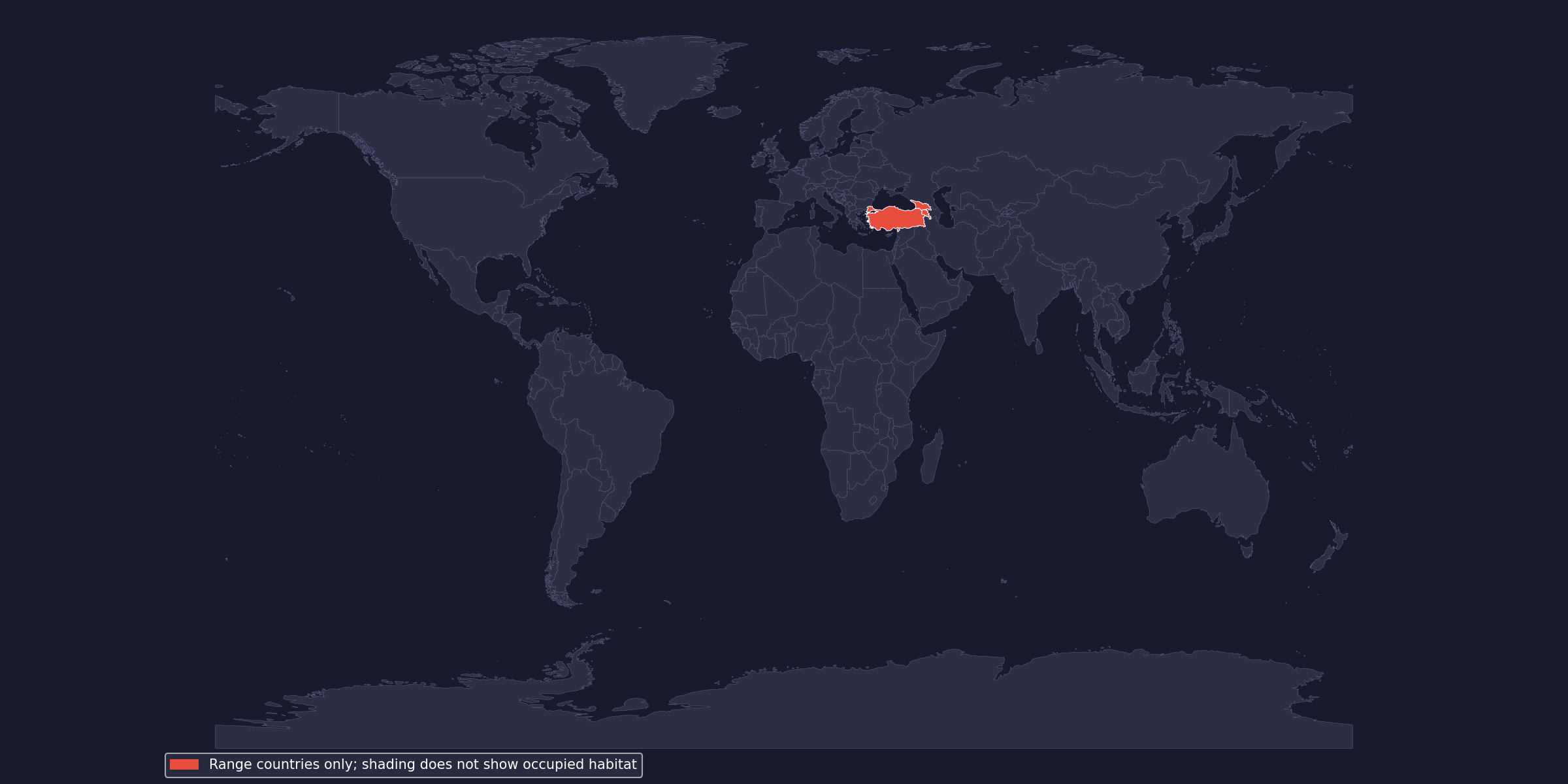
The accepted range includes Armenia, Georgia and northeastern Turkey. Rocky mountain grassland and deep fissures provide shelter; Armenian records include terrain around 2300–2800 m. The Ashotsk climate point represents the upland setting, not the conditions inside winter refuges. National shading greatly exceeds the occupied patches.
🌡 Climate across the native range
Outdoor monthly normals for representative terrain, not a verified snake observation or enclosure settings.
Ashotsk uplands — Armenia
| Month | Min °C | Mean °C | Max °C | RH % |
|---|---|---|---|---|
| January | -13.6 | -9.5 | -4.6 | 79 |
| February | -12.4 | -8 | -3.3 | 77 |
| March | -8.2 | -3.7 | 0.8 | 78 |
| April | -3.3 | 1.3 | 5.9 | 80 |
| May | 1.7 | 6.5 | 11.5 | 81 |
| June | 6.1 | 10.9 | 15.8 | 80 |
| July | 9.2 | 13.8 | 18.5 | 80 |
| August | 9.4 | 13.9 | 19 | 78 |
| September | 5.7 | 10.1 | 15.5 | 77 |
| October | 1 | 5.1 | 10.1 | 77 |
| November | -5.8 | -2 | 2.7 | 78 |
| December | -11.4 | -7.4 | -2.4 | 79 |
Weather data by Open-Meteo.com · CC BY 4.0 · Monthly normals calculated by Herpeton Academy from daily archive values.
⚖️ Legal status
Checked 17 September 2026: no listing under this species name was found in the CITES Appendices or the current EU wildlife-trade annexes. The CITES/EU entry for Vipera ursinii is geographically restricted and explicitly excludes populations in the former USSR. This is not permission to capture or own a viper. National capture, possession, registration, import, transport and sale rules still require a separate check.
Bern Appendix III covers reptiles not in Appendix II; the species is not named separately in Appendix II. Historical names within the kaznakovi or ursinii complexes can complicate the legal interpretation. Before transfer, ask the competent authority to confirm the applicable scope for the documented taxon and locality. Retain invoices, breeder identity, parentage and all origin/import permits.
☠️ Venom
A bite requires immediate hospital assessment. Pain, progressive swelling and tissue injury are possible; clotting disturbance, bleeding, low blood pressure and other systemic effects cannot be excluded. Clinical evidence for these uncommon vipers is limited, and laboratory toxicity or insect-eating habits do not predict a harmless human bite. A small snake, slight marks or an apparently dry bite provide no reassurance.
Move away, call emergency services, remove rings and tight clothing, keep the person still and support the limb without compression. Do not cut, suck, ice or tourniquet the wound, and do not delay transport to capture the snake. The receiving hospital and poison centre must decide on antivenom: effectiveness of a product made for another viper cannot be assumed. Agree that emergency pathway before acquiring the animal.
🤌 Husbandry
Keep one animal per locked enclosure inside a locked, access-controlled room with secondary containment. Use a shift compartment that permits isolation and visual confirmation before servicing; never free-handle. Written bite and escape plans, trained backup staff and a reptile veterinarian are prerequisites.
Quarantine separately for at least 90 days as a working minimum, extending it on veterinary advice. Use paper substrate and dedicated tools; record meals, weight or body condition, stools and sheds. Arrange parasite screening for uncertain origin, weight loss or abnormal faeces. Any examination or weighing must use an established protected-contact procedure.
💡 Lighting
Provide 12–14 hours of visible light in the active season and darkness at night. Shade and opaque hides must remain accessible. A species-specific UVB requirement is not established; any low-level UVB programme should be measured and reviewed by the veterinarian, with no forced exposure. Protect lamps and wiring from contact.
🌡 Heating and temperature
Prioritise shaded rock-like fissures and low cover for this small highland viper. The basking patch should warm the snake briefly without warming every hide; a separate room-cooling system is particularly important during summer heat. Measure air, basking surface and the cool hide separately; use thermostatic heating and test summer room cooling before acquisition.
Winter dormancy is a separate locality-specific programme for established healthy adults, agreed with the source institution and veterinarian. Do not copy freezing outdoor climate values, cool thin or sick animals, newly arrived or gravid females, or apply adult breeding cycles to juveniles. Preparation, hydration checks and recovery to feeding need a written protocol; no universal winter temperature is justified here.
💧 Humidity and water
Measure humidity near the resting animal; the table is a provisional band, not a reason to wet every surface. Provide a locally moist retreat and a dry resting option with cross-ventilation. Persistent condensation, sour substrate or avoidance of the moist hide needs investigation.
Keep clean drinking water available in a stable shallow bowl that can be serviced after isolating the snake. Forced soaking and manual removal of retained skin expose both keeper and animal to harm; recurrent shedding failure requires veterinary review.
🌿 Enclosure and decoration
A starting enclosure of 90 × 50 × 50 cm gives one adult room to stretch and choose between covered warm and cool areas; enlarge it for unusually large individuals. Secure every vent and cable gap, including against neonatal escape. Keep the shift door visible and reachable through the protected servicing system.
After quarantine, use about 5–8 cm of compactable, fertiliser-free soil mixed with washed sand, with leaf cover where appropriate. Maintain a dry upper resting surface and modest moisture locally below it. Fix stones to the base before adding substrate. Avoid collapsing rock piles, sharp gravel, aromatic wood and loose dusty sand. Feed on a clean surface: swallowed substrate, oversized prey and dehydration can contribute to impaction.
🐁 Feeding
Natural prey includes small vertebrates; do not assume that every juvenile will accept a thawed mouse. Acquire only an animal with a documented feeding history and continue the source institution’s successful diet. A mouse-eating adult may start with a modest meal every 10–14 days; juveniles need smaller meals, commonly every 7–10 days, adjusted by the veterinarian.
For vertebrate prey, start no wider than the snake’s widest body section; whole prey normally needs no routine vitamin or calcium dusting. Avoid live rodents and feeding disturbance. Never attempt force-feeding at home. Persistent refusal with weight loss, regurgitation or mouth discharge needs diagnosis rather than progressively larger meals.
🥚 Breeding
This is a live-bearing species; there is no egg-incubation schedule. Males often have relatively longer tails, but visual clues are not sufficient for a breeding decision: have sex confirmed through a professional protected procedure. Reliable universal maturity ages are not established; use documented age, adult size, body condition and the source institution’s records.
Pair only healthy mature animals of compatible documented locality under a specialist plan. Gestation and recovery can be costly for small females, so do not assume annual breeding is appropriate. Prepare separate locked neonatal housing, feeding expertise and lawful placements before pairing. Keep records of parentage, births, sheds and first meals.
🩺 Common problems
- Overheating: unusual exposed resting or repeated escape attempts warrant immediate checks of the cool hide and room.
- Respiratory infection: bubbles, wheezing or open-mouth breathing need prompt reptile-veterinary assessment.
- Dysecdysis, dehydration and dermatitis: check water access, refuge moisture and wet dirty substrate; do not manually strip skin.
- Obesity, impaction or parasites: track meals, stools and body condition; persistent change needs diagnosis.
- Reproductive problems: prolonged abnormal swelling, weakness or unsuccessful birth requires urgent veterinary advice.
📌 Conclusion
A Darevsky’s viper should arrive with a working diet and an institution-level provenance record. If the cool refuge cannot be maintained through summer, acquisition should wait even when the enclosure and permits are otherwise ready.
📚 Sources and further reading
ReptiFiles was searched first on 17 September 2026; no species-specific guide was found. Distribution and taxonomic references establish natural-history context, not tested terrarium targets. The official keeping guidance supports containment; numerical care values are explicitly provisional. Venom studies support caution, not an antivenom recommendation.
- Reptile Database: Vipera darevskii
- GBIF: Vipera darevskii
- ReptiFiles
- Caucasian viper natural history and taxonomy
- Taxonomic revision (Freitas et al. 2020)
- Venom and insect feeding research
- Vipera kaznakovi venom variation
- WHO: snakebite treatment and first aid
- Official guidance on keeping venomous snakes
- UV-Tool (Baines et al. 2016)
- CITES Appendices, 5 March 2026
- EU wildlife-trade annexes, Regulation 2026/1383
- Bern Convention Appendix II
- Bern Convention Appendix III
- Bern Convention amendments