Share

Anatolian Meadow Viper
🔤 Taxonomy
Vipera anatolica includes the named subspecies anatolica and senliki. Older literature placed it within V. ursinii. Keep subspecies, locality and feeding history together; a general meadow-viper label conceals important differences.
📌 Description
A very small Turkish mountain viper, roughly 30–45 cm for adult planning. A zigzag dorsal pattern does not establish subspecies. Its restricted wild populations and unusual prey requirements make a documented conservation collection the appropriate context.
The table gives provisional active-season starting points, not measured species optima or safety limits. Enclosure dimensions are practical recommendations; increase them for larger animals. Reliable species-specific lifespan data are insufficient for a promise. These animals require an experienced, legally authorised venomous-snake facility, not ordinary pet handling.
📋 Quick reference
| Parameter | Provisional active-season target |
|---|---|
| Adult length | 30–45 cm |
| Enclosure, one adult | 90 × 50 × 50 cm |
| Air | 20–24°C |
| Basking surface | 27–29°C |
| Cool retreat | 17–21°C |
| Night air | 15–19°C |
| Relative humidity | 45–65% |
☠️ Venom
Bite severity varies; a small wound or an apparently dry bite does not exclude delayed envenoming.
Species-specific human bite evidence is limited. An invertebrate-rich diet does not make venom harmless to people. Treat every bite as an emergency: painful swelling and systemic illness are possible, and severity cannot be predicted from size. European-viper antivenom must not be presumed effective for this exact taxon without poison-centre assessment.
Call emergency services immediately, keep the person still, remove rings and tight items, and support the limb without compression. Do not cut, suck, apply ice or a tourniquet, or delay transport to capture the snake. Establish receiving-hospital and poison-centre arrangements before acquisition. Antivenom selection and administration belong to clinicians.
🌍 Distribution
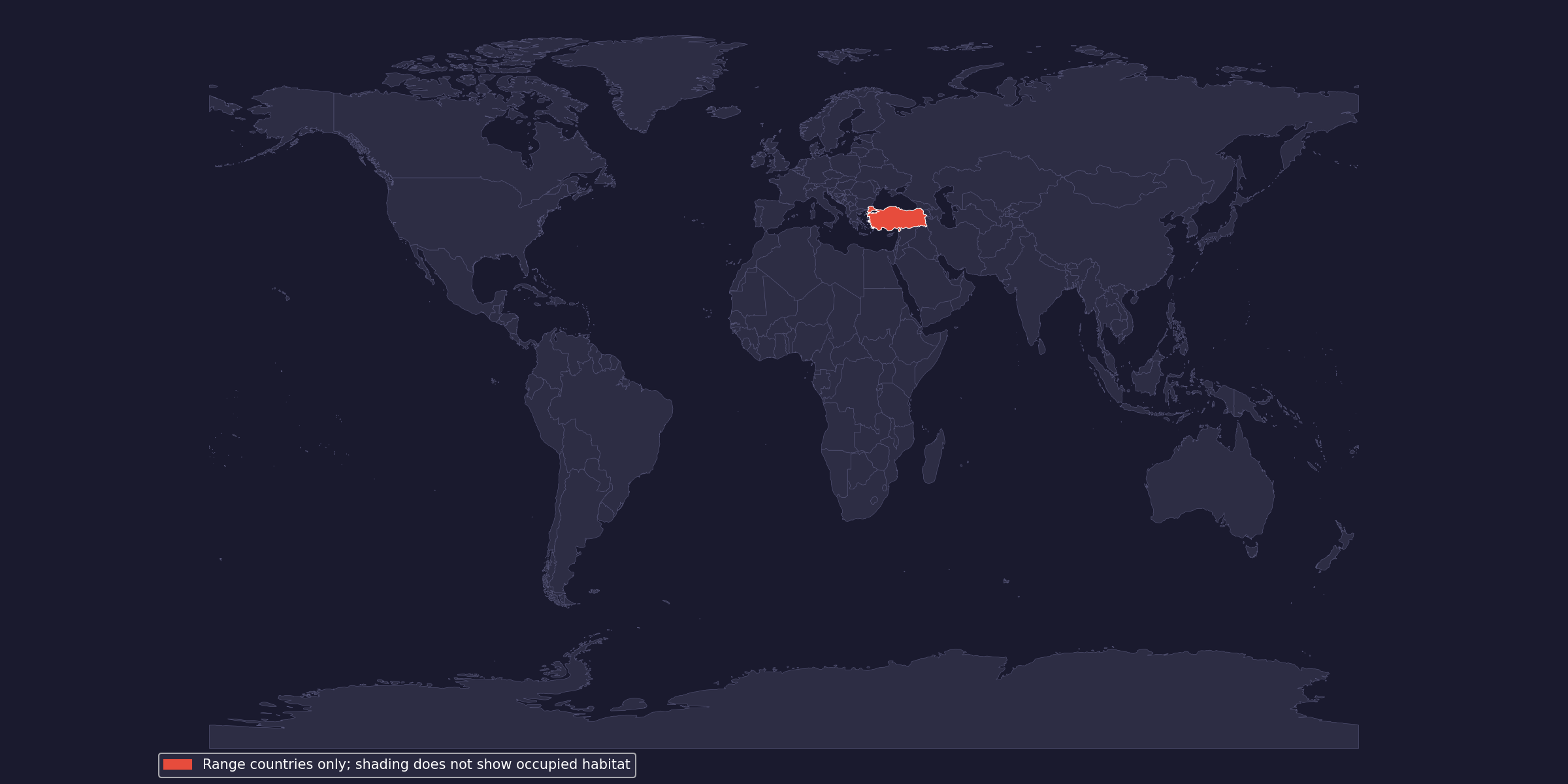
Endemic to southwestern Türkiye, with the Kohu Dağı/Çığlıkara and Mühür Dağı groups in the Antalya region. Mountain steppe, limestone hollows, stones and vegetation provide shelter; senliki sites can have denser, wetter vegetation than the western karst plains. The two climate points retain this geographic distinction.
Climate tables use WorldClim 2.1 regional grids for 1970–2000; relative humidity is derived from temperature and water-vapour pressure. The approximately 10-minute grid averages terrain and does not measure the snake’s mountain slope, perch or burrow.
🌡 Climate across the native range
Outdoor monthly averages show seasonal context, not enclosure settings or the temperature inside a shelter.
Kohu Dağı — Türkiye
| Month | Min °C | Mean °C | Max °C | RH % |
|---|---|---|---|---|
| January | -3.4 | 1.1 | 5.6 | 74 |
| February | -2.5 | 2.3 | 7.1 | 67 |
| March | -0.3 | 5.3 | 10.9 | 59 |
| April | 3.6 | 9.5 | 15.4 | 52 |
| May | 7.3 | 13.9 | 20.4 | 50 |
| June | 11.1 | 18.3 | 25.4 | 42 |
| July | 14.1 | 21.5 | 28.9 | 37 |
| August | 13.9 | 21.5 | 29.1 | 38 |
| September | 10.3 | 17.9 | 25.5 | 41 |
| October | 5.8 | 12.4 | 19.1 | 52 |
| November | 1.5 | 7.1 | 12.6 | 66 |
| December | -1.6 | 2.8 | 7.2 | 77 |
Mühür Dağı — Türkiye
| Month | Min °C | Mean °C | Max °C | RH % |
|---|---|---|---|---|
| January | -8.6 | -4.9 | -1.2 | 86 |
| February | -7.6 | -3.6 | 0.3 | 79 |
| March | -4.5 | -0.4 | 3.6 | 65 |
| April | 0.4 | 4.7 | 9.1 | 54 |
| May | 4 | 9.3 | 14.5 | 52 |
| June | 7.4 | 13.3 | 19.2 | 44 |
| July | 10.1 | 16.5 | 22.8 | 36 |
| August | 9.7 | 16.3 | 22.8 | 38 |
| September | 6.4 | 12.9 | 19.4 | 42 |
| October | 2.2 | 7.6 | 13.1 | 54 |
| November | -2 | 2.3 | 6.6 | 70 |
| December | -6 | -2.5 | 1.1 | 84 |
Weather data by WorldClim v2.1 · Monthly normals queried by Herpeton Academy from raster values; relative humidity is derived from vapor pressure and mean temperature.
⚖️ Legal status
No separate CITES or EU wildlife-trade entry was found. The historical V. ursinii Appendix I/Annex A entry is limited to European populations outside the former USSR; southwestern Anatolia is outside that geographical clause. Bern Appendix II lists ursinii, so historical taxonomic coverage for anatolica must be resolved with authorities; this uncertainty must not be treated as an exemption.
Checked 17 September 2026. Trade status does not authorise wild collection or possession. Confirm national protection, dangerous-animal permits, import, registration, transport, breeding and sale rules with the competent authority. Keep breeder identity, invoice, parentage, locality and transfer/import paperwork.
🤌 Husbandry
Use low cover and stable stones with both dry and locally moist retreats. The thermal bands are provisional choices based on the published mountain habitat and comparative small-Vipera care, not measured optima for anatolica. The 2017 and 2025 field papers support habitat complexity and regional differences; they do not establish an enclosure humidity percentage or floor minimum.
House individually in a locked enclosure inside a locked, escape-resistant room. A lockable shift compartment must permit visual confirmation and isolation before water changes or cleaning. Have trained backup staff, a written escape plan and a reptile veterinarian ready. No free handling or improvised restraint.
Use at least 90 days of separate quarantine as a working minimum, extended by the veterinarian when needed. Start with paper substrate and dedicated tools; record feeding, sheds, faeces and body condition. Unknown-origin animals, weight loss or abnormal stools justify veterinary assessment and parasite testing. Obtain weights only by an established protected procedure.
💡 Lighting
Provide 12–14 hours of visible light in the active season and darkness at night. Keep full shade available. No species-specific UVB optimum is established; if low-level UVB is used, measure exposure and review the arrangement with the veterinarian using the UV-Tool reference. Guard lamps and adjust seasonal day length gradually, in step with the approved winter plan.
🌡 Heating and temperature
Use the separate air, surface and cool-retreat values in the table as provisional starting points. Thermostat-controlled, guarded heating should warm only part of the enclosure. Measure the basking surface and both retreats independently; check the coolest area during summer room-temperature peaks. A heater thermostat cannot correct an overheated room.
Adjust photoperiod and seasonal temperatures gradually from documented locality and breeder records. Do not prescribe refrigerator brumation from outdoor winter averages. Only healthy, established adults should enter a veterinarian-approved seasonal breeding programme; newly acquired, thin or sick animals and juveniles require separate decisions.
💧 Humidity and water
Measure relative humidity near the resting animal, using the table as a provisional band. Keep a slightly moist refuge alongside dry resting surfaces; avoid wetting the whole floor. Ventilation and local moisture are more useful than chasing a single percentage. Supply fresh water continuously in a stable bowl, serviced only after isolation. Persistent poor sheds require a hydration and health review, not forced soaking or peeling.
🌿 Enclosure and decoration
Give the snake enough uninterrupted floor length to stretch fully. Secure ventilation mesh, doors and cable entries, checking gaps against the smallest animal present. Place cover in both thermal zones and fix stones against collapse. After quarantine, 5–8 cm of compactable soil mixed with washed sand, with a little leaf litter, can provide firm footing and local moisture. Keep most of the surface dry. Avoid sharp gravel, aromatic wood and inaccessible cavities; paper remains useful for sick animals.
🐁 Feeding
The original senliki study found centipedes and millipedes as principal prey, with other invertebrate remains; some small remains may represent prey eaten by those invertebrates. This is not proof that a cricket-only or mouse-only diet is adequate. Acquisition requires a demonstrated, sustainable captive diet and a veterinarian’s nutrition plan, including calcium and vitamins for invertebrate feeding. Do not collect wild centipedes or introduce injurious live prey as an experiment. No defensible universal meal interval is given; record acceptance, body condition and juvenile growth.
For accepted feeder insects, use prey no broader than the snake’s body and maintain well-fed feeder cultures before offering them. Agree a calcium-without-D3 plan when measured UVB is provided; oral D3 and multivitamins, including vitamin A, must account for UVB exposure, juvenile growth, reproduction and product-label limits. Avoid overlapping supplements or guessing a species dose. Keep food off loose substrate: swallowed particles, dehydration and low temperature increase impaction risk. Never force-feed a venomous snake at home.
🥚 Breeding
This viper bears live young; there is no egg-incubation schedule. Sex should be confirmed by an experienced professional, not home probing. Breed only mature, healthy animals with documented parentage and locality; no defensible universal age threshold was found for these lineages. Keep locality lines separate. Before pairing, prepare individually secured neonatal housing, a protected separation procedure and lawful placements; small newborns are venomous and can escape through much smaller gaps.
🩺 Common problems
Persistent exposed resting or attempts to escape the warm zone warrant an immediate temperature check. Wheezing, bubbles or open-mouth breathing suggest respiratory disease; abnormal belly scales may indicate dermatitis. Repeated poor sheds, regurgitation, weight loss or abnormal faeces require a reptile veterinarian to distinguish dehydration, dietary problems, parasites and other illness. Do not deworm or restrain a venomous snake yourself; arrange secure professional transport.
📌 Conclusion
Proceed only when lawful provenance, the demonstrated diet, suitable secure housing and a written medical plan are all in place. The documented locality and individual records should drive revisions to this provisional care plan.
📚 Sources and further reading
ReptiFiles was checked first on 17 September 2026; no species-specific guide was found. Older husbandry reports inform comparison, not modern handling, drug treatment or blanket reproduction instructions.
- Reptile Database: Vipera anatolica
- GBIF: Vipera anatolica
- Original senliki description and diet, 2017
- Taxonomy, distribution and conservation, 2025
- Comparative meadow-viper husbandry
- WHO: snakebite treatment
- Official venomous-reptile containment guidance
- UV-Tool: measured, species-aware lighting
- CITES: current Appendices
- EU wildlife-trade annexes, 2026
- Bern Convention Appendix II
- Bern Convention Appendix III
- WorldClim 2.1 climate data
- ReptiFiles