Share

Mulga Snake
🔤 Taxonomy
Pseudechis australis is the currently accepted scientific name. The historically important combination Naja australis still appears in older literature. Despite the name king brown snake, it is a black snake in Pseudechis, not a brown snake in Pseudonaja.
Identification must use reliable provenance and diagnostic characters rather than colour alone; locality records are especially important where related elapids overlap.
📌 Description
Mulga Snake is a fast, highly venomous elapid reaching roughly 150-250 cm and requiring a commitment of about 15-25 years. It is an expert-only, display-only animal for a purpose-built venomous facility. A calm captive individual remains capable of life-threatening envenomation.
It is not a spitting cobra, but any bite is an immediate medical emergency; apparent reluctance to strike is never a safety control.
📋 Quick reference
| Care point | Practical target |
|---|---|
| Adult size and lifespan | 150-250 cm; about 15-25 years |
| Adult enclosure | At least 250 x 120 x 120 cm with two externally locked shift hides |
| Temperature | Ambient 25-30°C; basking 32-35°C; cool refuge 22-25°C |
| Humidity | 30-50%, with local shed support |
| Feeding | Frozen-thawed rodents, normally every 10-21 days |
| Safety | Protected contact, two trained staff, bite and escape plans |
| Quarantine | At least 90 days with separate tools and parasite assessment |
☠️ Venom
This species is venomous. Venom exposure can cause pain, swelling or other systemic effects, and severity varies with species, locality, bite site and the amount delivered. A small wound or apparently dry bite is not proof of safety; every bite or sting requires urgent medical assessment.
If an incident occurs, move away, call emergency services or a poison centre, keep the patient still, remove rings and other constricting items, and follow dispatcher instructions. Do not use a tourniquet, cut or suck the wound, apply ice or electricity, give alcohol or medicines as a home treatment, or attempt to catch the animal. Antivenom choice and dosing are hospital decisions; verify the relevant product and local availability in advance. Sources: WHO snakebite guidance and appropriate species-specific toxinology or medical references listed below.
🌍 Distribution
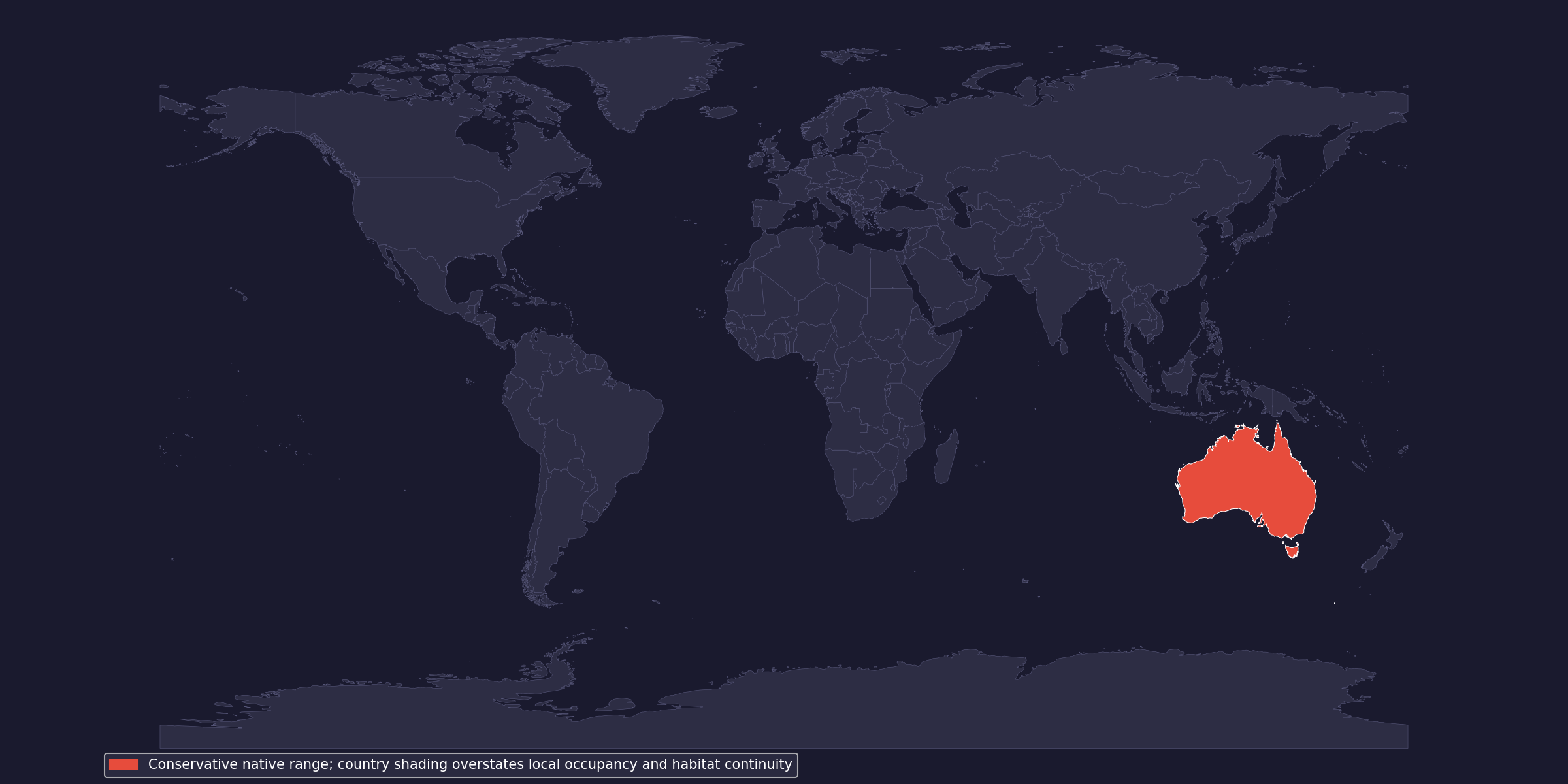
The documented native range covers most of mainland Australia outside the wetter southeastern and southwestern coastal districts. It uses desert, hummock grassland, scrub, open woodland and dry watercourses. Country-level shading overstates local occupancy and should not be read as continuous distribution.
⚖️ Legal status
Pseudechis australis is not currently listed in the CITES Appendices, and no species-specific EU wildlife-trade annex listing was found. No species-specific Bern Convention listing applies. This status was checked against the official CITES, EU and Bern sources on 4 September 2026.
Local and national dangerous-animal, wildlife, import, transport, breeding and sale rules remain separate and may require permits, inspection, insurance or prohibit private possession. Obtain written confirmation before acquisition and retain invoices, breeder details, identification photographs, origin and transfer/import documents.
🤌 Husbandry
House this species singly in a locked venomous-animal room with secondary containment. Connect the enclosure to two full-body shift hides that close and lock externally. Water, waste and removable furniture are serviced only after positive visual confirmation that the snake is secured in the other compartment. Free handling, necking and routine manual restraint are unacceptable.
Quarantine every arrival for at least 90 days on paper with separate tools and preferably separate air. Record weight, feeding, sheds, faeces, skin, mouth and respiration. Animals of uncertain origin need identification review, parasite testing and veterinary assessment before permanent housing.
💡 Lighting
Provide 10-13 hours of broad visible light, complete darkness at night and opaque shaded retreats. Low-level UVB over part of the warm zone may offer Ferguson Zone 2 exposure, but the snake must be able to avoid it completely. Mount or guard every fitting outside reach.
🌡 Heating and temperature
Maintain ambient air at 25-30°C, a local basking surface at 32-35°C, a cool refuge at 22-25°C and nights around 20-24°C. Thermostat every heater independently and verify air and surfaces at snake level.
Seasonal reduction belongs only in a locality-backed programme for healthy established adults. Never cool juveniles, thin animals, new arrivals or snakes with respiratory signs, and always preserve a usable gradient.
💧 Humidity and water
Maintain a ventilated 30-50% baseline and a local humid hide around 55-70% during shedding. Keep most substrate dry enough to prevent dermatitis and stale-air respiratory disease. Provide a heavy clean bowl that can be exchanged through protected access and monitor drinking, urates, mass and shed quality.
🌿 Enclosure and decoration
Use at least 250 x 120 x 120 cm for a typical adult and enlarge for unusually long or active animals. Provide two externally operated shift hides, anchored cover, low shelves or branches, visual barriers and an unobstructed route between shifts. The layout must allow staff to account for the whole animal before any port opens.
Use 13-17 cm of compactable low-dust soil-based substrate, or paper during quarantine. Avoid aromatic wood, sharp or unstable décor, adhesive tape and inaccessible cavities. Guard vents and cable ports, use two independent locks and label the enclosure with taxon, animal count, venom risk and emergency contacts.
🐁 Feeding
Offer appropriately sized frozen-thawed whole rodents, usually every 10-21 days, adjusted to age, body condition, activity and reproductive state. Smaller moderate meals are safer than oversized prey. Whole vertebrate prey needs no routine supplement.
Feed through a protected port and secure the snake before recovering remains. Live prey creates avoidable injuries and unsafe service work. Persistent refusal or regurgitation calls for review of temperature, security, parasites and disease, not repeated handling.
🛡 Operational safety and emergencies
Use protected contact, locked shifts, rigid transparent barriers and task-specific tools. Two trained adults attend every primary opening. Keep current inventory, lock and drill records, species identification, escape equipment and a written bite plan. Before acquisition, agree the receiving hospital, poison-centre advice, transport and antivenom consultation pathway; private antivenom administration is not a medical plan.
Every suspected bite is an immediate emergency: withdraw safely, call emergency services, keep the patient still and follow the pre-agreed professional protocol. Do not cut, suck, ice, shock, apply chemicals or use a tight arterial tourniquet, and never delay transport to catch the snake.
🥚 Breeding notes
This species is oviparous, with reported clutches commonly around 4-19 eggs. A conservative captive planning range is 27-29°C for about 70-100 days; calibrated equipment and egg-level records matter more than a nominal incubator setting. Breeding requires remote separation, secure individual neonatal boxes, permits and lawful qualified placements before pairing.
🩺 Common problems
- Rostral trauma: repeated rubbing suggests reflections, poor cover or unsuitable shift geometry.
- Burns and heat stress: guard and thermostat every source while retaining a measured cool refuge.
- Respiratory disease: wheeze, bubbles, open-mouth breathing or abnormal posture requires urgent reptile-veterinary assessment.
- Dermatitis and dysecdysis: correct saturation, stale air, dehydration and missing textured surfaces without manually restraining the snake.
- Parasites and stomatitis: uncertain-origin animals require strict quarantine and diagnostics.
- Obesity or regurgitation: review prey size, intervals, heat and disturbance.
- Egg retention: prolonged straining or failure to settle requires a remote veterinary plan, not manual examination.
📌 Conclusion
Mulga Snake belongs only in a licensed, escape-contained facility where every routine task can be completed behind a locked barrier. The enclosure, trained team and hospital-coordinated emergency plan must be operational before the animal arrives.
📚 Sources and further reading
- ReptiFiles
- The Reptile Database: Pseudechis australis
- GBIF: Pseudechis australis
- Australian Museum
- Australian Venom Research Unit: Pseudechis
- CITES
- European Commission: wildlife-trade legislation
- Bern Convention