Share

Sunda King Cobra
🔤 Taxonomy
Ophiophagus bungarus is the Sunda king cobra, revived as a species in the 2024 revision of the former O. hannah complex. It covers populations south of the Isthmus of Kra through the Sunda Shelf and parts of the southern and central Philippines. Older permits, studbooks and labels commonly call these animals O. hannah. GBIF had not yet supplied a species-level key at the 4 September 2026 check, so the taxonomy widget stops at the correctly matched genus rather than linking this page to the wrong species.
📌 Description
This is an enormous, intelligent and medically dangerous snake for licensed institutions, not private pet keeping. Adults commonly exceed 3 m and may approach 5 m. They travel, climb, investigate doors and can raise a long section of the body. Venom may cause rapidly progressive neuroparalysis and respiratory failure, while the animal’s reach and venom yield magnify every procedural error.
| Enclosure and decoration | 600 × 300 × 300 cm |
| Heating and temperature | 25-29°C; basking 30-32°C |
| Humidity and water | 70-90% |
| Feeding | 10-21 days |
☠️ Venom
This species is venomous. Venom exposure can cause pain, swelling or other systemic effects, and severity varies with species, locality, bite site and the amount delivered. A small wound or apparently dry bite is not proof of safety; every bite or sting requires urgent medical assessment.
If an incident occurs, move away, call emergency services or a poison centre, keep the patient still, remove rings and other constricting items, and follow dispatcher instructions. Do not use a tourniquet, cut or suck the wound, apply ice or electricity, give alcohol or medicines as a home treatment, or attempt to catch the animal. Antivenom choice and dosing are hospital decisions; verify the relevant product and local availability in advance. Sources: WHO snakebite guidance and appropriate species-specific toxinology or medical references listed below.
🌍 Distribution
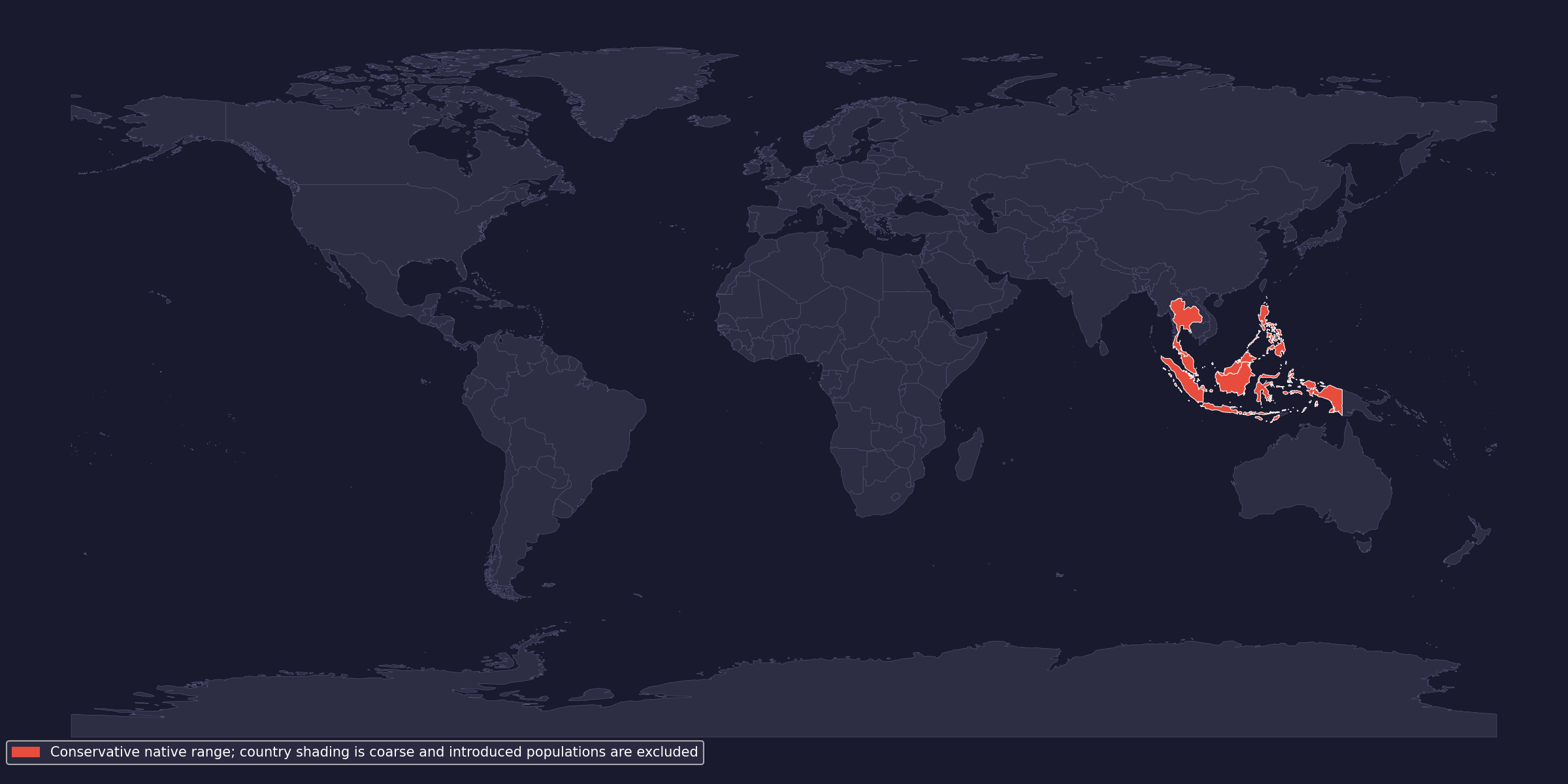
The native range includes southern Thailand, Peninsular Malaysia, Singapore, Sumatra, Java, Borneo, Bali and intervening Sunda islands, plus Palawan and Mindoro in the Philippines. It uses humid forest, wetlands, mangrove margins and wooded agricultural mosaics, often near water. Country shading is necessarily coarse and does not show the Kra Isthmus boundary or island-level absences.
⚖️ Legal status
King cobras are covered by CITES Appendix II and EU Annex B trade controls, but the legal nomenclature is still catching up with the 2024 split. Obtain written confirmation from the competent authority about how O. bungarus must appear on permits and certificates. Dangerous-animal licensing, inspected rooms, insurance, transport restrictions and emergency plans may also apply. Retain origin, parentage, photographs, identifiers, invoices and every transfer or import record.
The Bern Convention is not relevant because this species is not native to Europe. Local and national ownership, registration, transport, breeding and sale rules may still apply.
🤌 Husbandry
Only a locked venomous-animal suite with room-level secondary containment is acceptable. The primary enclosure must connect to two full-length, externally operated shift compartments. Staff must be able to locate, shift and positively isolate the entire snake before opening a service hatch. Quarantine for at least 90 days in a separate secure air space with dedicated tools, weight records and parasite screening.
💡 Lighting
Provide bright broad-spectrum daylight for 11-13 hours, complete darkness at night and extensive shade. Guard all lamps and cables. Measured low-level UVB may be offered over part of the warm zone, with full retreat from both heat and ultraviolet exposure.
🌡 Heating and temperature
Maintain ambient air at 25-29°C, a local basking surface at 30-32°C, a 23-25°C cool retreat and nights near 23-25°C. Large rooms need several calibrated sensors and separately guarded, thermostatically controlled heaters. Never make the whole enclosure as warm as the basking site.
- 25-29°C
- basking: 30-32°C
- cool: 23-25°C
- night: 23-25°C
💧 Humidity and water
Maintain 70-90% humidity with strong ventilation and local 80-95% shed support. Provide a stable basin that can be drained and serviced from protected access. Drainage, leaf litter and humid retreats are safer than continuously wet floors and stagnant air.
🌿 Enclosure and decoration
An adult suite should provide at least 600 × 300 × 300 cm, more for animals approaching 5 m, plus two full-body shifts. Install broad anchored shelves, trunks, visual barriers, ground hides and a route that does not terminate above a door. Use 15-20 cm of well-drained soil and leaf litter after quarantine. Every vent and hatch needs redundant mechanical security.
🐍 Feeding
This species is a snake specialist. Establish a legal, biosecure supply of identified, disease-screened, safely killed or frozen-thawed snake prey before acquisition. Adults are usually offered moderate meals every 10-21 days; juveniles need smaller, more frequent meals. Do not substitute a permanent rodent diet without veterinary nutritional review and never use wild-caught feeder reptiles.
🛡 Operational safety
Use protected contact, lockable shifts, rigid shields and a written two-person procedure. Before acquisition, the regional poison centre and receiving hospital must confirm transport, airway and ventilation capability, critical care and an antivenom strategy appropriate to the lineage. Every bite is an emergency: secure the room, call emergency services, keep the patient still and follow poison-centre instructions. Do not cut, suck, ice, shock or tourniquet the bite.
🥚 Breeding
Females build and guard nests. Reported king-cobra clutches commonly contain 20-40 eggs, often incubated near 26-28°C for roughly 70-90 days, but species-specific published data remain limited. Breeding requires a remote-lockable nesting module, same-species provenance and secure permitted placements for every offspring.
🩺 Common problems
Important problems include incomplete lineage records, escapes, obesity, prey-borne parasites, regurgitation, retained shed, mouth trauma, dermatitis and respiratory disease from warm stagnant air. Refusal to feed, weak posture, abnormal breathing or neurological signs require protected isolation and an experienced reptile veterinarian.
📌 Conclusion
This species belongs only in a licensed institution that has the room, trained team, prey chain and medical agreement operating before the animal arrives. A large cage and snake-handling experience alone are not an adequate safety system.