Share

Lebanon Viper
🔤 Taxonomy
Montivipera bornmuelleri is the Lebanon viper, formerly Vipera bornmuelleri. It is distinct from the Bolkar viper; older records from the Syrian coastal mountains need checking against the later identification as M. bulgardaghica. Preserve the collection locality instead of relying on a country label.
Compare the separate guide to Montivipera bulgardaghica before transferring a care protocol between taxa.
📌 Description
This relatively small mountain viper is often around 40-50 cm, with larger animals approaching 75 cm. A reduced, broken dorsal pattern can make adults look less strongly marked than other mountain vipers. Its modest size does not reduce the need for full venomous-snake containment. The central care problem is providing cool upland conditions through a hot summer.
The numerical targets below are conservative starting points for an experienced collection, informed by mountain-viper husbandry and natural history. They are not experimentally established optima or tolerance limits for this species. Enclosure dimensions are a practical recommendation, not a published minimum. Keep locality records and adjust with an experienced reptile veterinarian; species-specific longevity data are too limited to promise a lifespan.
📋 Quick reference
| Care point | Provisional active-season target |
|---|---|
| Adult length | 40-75 cm |
| Enclosure, one adult | 120 × 60 × 60 cm |
| Ambient air | 18-24°C |
| Basking surface | 26-28°C |
| Cool retreat | 16-20°C |
| Night air | 14-18°C |
| Relative humidity | 50-70% |
| Adult meals | Every 14-21 days |
🌍 Distribution
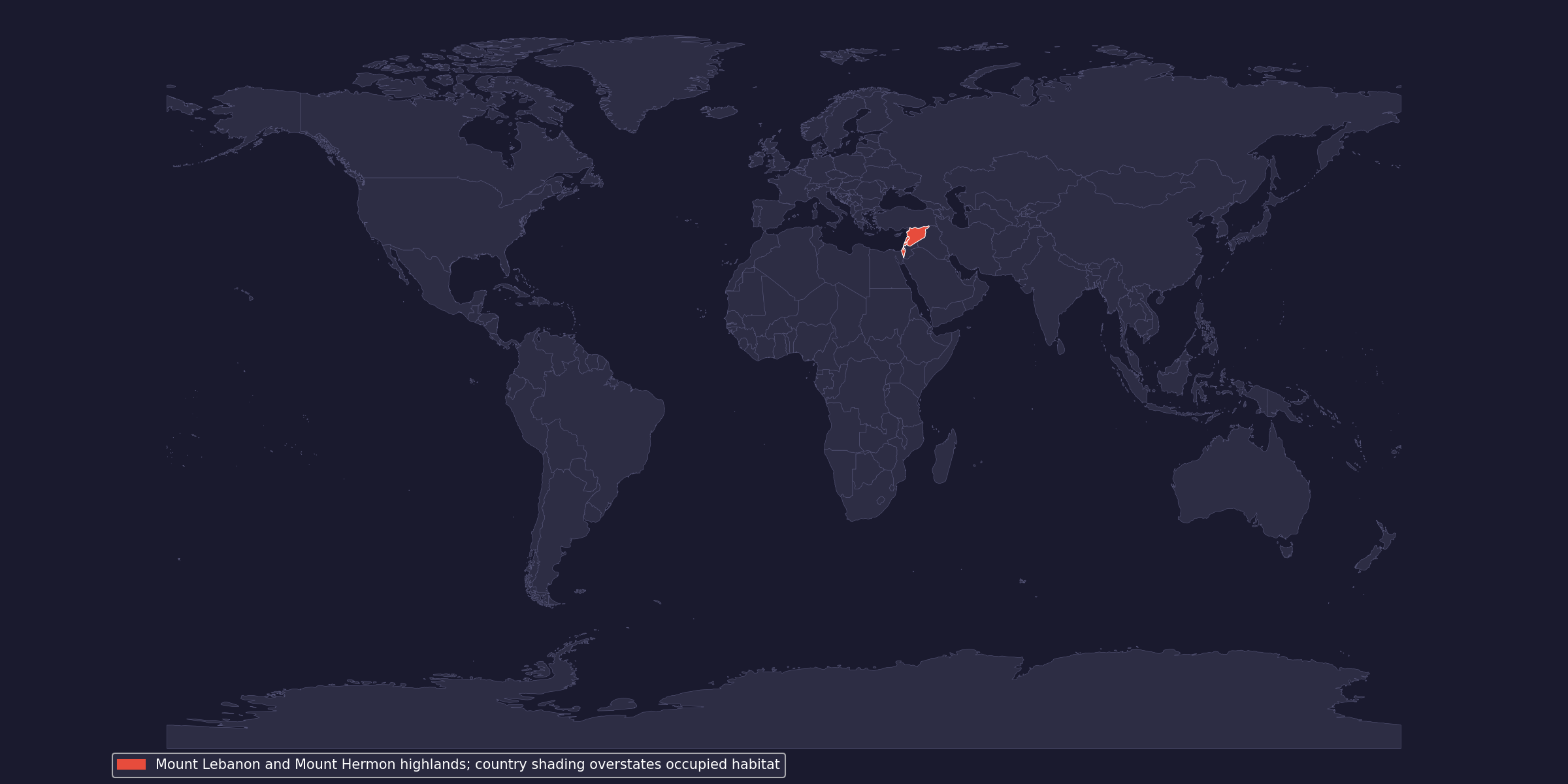
Found in the Mount Lebanon and Mount Hermon highlands; country lists include Lebanon, Syria and Israel. The occupied habitat is high mountain terrain, not the warm lowland coast. Rocks, sparse scrub and seasonal snow form a sharply seasonal environment. Country shading substantially overstates the narrow upland distribution; the climate point is representative terrain, not a verified snake observation.
🌡 Climate across the native range
Monthly outdoor normals provide seasonal context, not enclosure settings. Mountain crevices and winter refuges differ from these grid averages.
Mount Lebanon — Lebanon (representative upland location)
| Month | Min °C | Mean °C | Max °C | RH % |
|---|---|---|---|---|
| January | -5.3 | -1.3 | 2.8 | 78 |
| February | -4.9 | -0.6 | 3.6 | 77 |
| March | -2.2 | 2.5 | 7 | 72 |
| April | 1.4 | 6.7 | 11.3 | 65 |
| May | 6 | 11.3 | 15.9 | 58 |
| June | 10.2 | 15.4 | 20.2 | 52 |
| July | 13.1 | 18.1 | 23 | 51 |
| August | 13.1 | 18.1 | 23.3 | 56 |
| September | 10.8 | 15.7 | 20.8 | 58 |
| October | 6.6 | 11.3 | 16.2 | 61 |
| November | 0.9 | 5.2 | 10 | 69 |
| December | -3 | 1.1 | 5.4 | 76 |
Weather data by Open-Meteo.com · CC BY 4.0 · Monthly normals calculated by Herpeton Academy from daily archive values.
⚖️ Legal status
No CITES or specific EU wildlife-trade annex listing was found in the reviewed lists. Bern Appendix III covers reptiles not included in Appendix II where the Convention applies; do not confuse that general provision with an ownership permit or assume identical implementation across the range states.
Legal review: 17 September 2026. Check the accepted name and older Vipera combination. National rules on capture, possession, registration, transport, breeding, sale and import can be stricter than the treaty listings. Obtain written confirmation from the relevant authority before a transfer, and retain the invoice, breeder details, parentage, locality and permit documents. A captive-bred label alone does not establish lawful origin.
☠️ Venom
A bite is a medical emergency: expect potentially severe pain, swelling and tissue injury, with possible clotting disturbances, bleeding or systemic illness. Clinical reports are sparse and venom effects differ between taxa and individuals; laboratory findings cannot predict the course of a particular bite. Neither a small snake nor an apparently dry bite is reassuring.
Move away, call emergency services, remove rings and other tight items, keep the person still and support the limb without compression. Do not cut, suck, ice or tourniquet the wound, or delay transport to catch the snake. Follow poison-centre instructions. Antivenom choice and availability must be agreed with a receiving hospital in advance; a product intended for another viper is not automatically effective. Treatment belongs in hospital.
🤌 Husbandry
Keep one animal per enclosure in a locked, access-controlled venomous-reptile room with secondary containment. Provide lockable shift compartments that allow the snake to be isolated and visually accounted for before cleaning or changing water. A written bite and escape plan, trained backup keeper and an agreed veterinary service must exist before acquisition. Never free-handle or attempt home restraint.
Quarantine new arrivals separately for at least 90 days as a working minimum, extending it if the veterinarian advises. Use dedicated tools, simple furnishings and paper substrate; record meals, sheds, faeces and body condition. Arrange parasite screening and veterinary review for animals of uncertain origin, weight loss or abnormal stools. Weigh only through an established protected-contact procedure.
💡 Lighting
Use a timer for about 12-14 hours of visible light during the active season, with complete darkness at night. Shorten daylight gradually only as part of a planned seasonal programme. Hides must allow complete retreat from the lamps.
A species-specific UVB requirement has not been established. If low-level UVB is provided, measure exposure, retain deep shade and have the lamp arrangement reviewed by the collection veterinarian. Do not assign a high-output lamp from habitat photographs alone; keep all electrical fittings outside reach or securely guarded.
🌡 Heating and temperature
Use provisional active-season air of 18-24°C, a small basking surface at 26-28°C, a 16-20°C retreat and nights around 14-18°C. These comparatively cool targets are an inference from upland ecology and related-viper care, not a validated bornmuelleri protocol. Secure room cooling is essential before summer.
Measure ambient air and basking surfaces separately, with an additional probe inside the cool retreat. Control heating with a thermostat and protect lamps from contact. Test the enclosure through the hottest part of the day before introducing the snake; a thermostat cannot cool an already hot room.
Winter dormancy requires a separate, locality-specific plan for established healthy adults. It is not an automatic consequence of a cold month in the climate table. Do not cool thin, sick, newly acquired or gravid animals, and do not apply an adult breeding cycle to juveniles. Obtain a documented protocol covering preparation, hydration, monitoring and return to feeding rather than improvising a refrigerator cycle.
💧 Humidity and water
Treat the humidity range as an initial management band, measured near the snake rather than beside a wet bowl. Maintain ventilation and a dry resting surface, with a locally moist retreat available during shedding. Persistent condensation calls for a ventilation and temperature review; an air-humidity percentage does not justify wet bedding.
Provide clean drinking water continuously in a stable bowl accessible through protected servicing. Check water and urates daily. Do not force soaking or peel retained skin; recurrent shedding difficulty needs a review of hydration, conditions and health.
🌿 Enclosure and decoration
Use the dimensions in the table for one adult, increasing floor space for an unusually large individual. The snake must be able to stretch fully. Fit independent locks, secure ventilation mesh and seal cable openings; assess gaps against neonate size if breeding is planned. Keep both the warm and cool retreats accessible.
Once quarantine is complete, a roughly 5-8 cm layer of compactable soil mixed with washed sand can support stable footing and a slightly moist lower layer. Keep most of the surface dry. Use fixed slabs or artificial rocks, low cover and clear sightlines to shift doors. Avoid unstable stone piles, sharp gravel, aromatic wood and deep loose sand. Remove waste promptly after isolating the snake; a planted enclosure still needs inspection.
🐁 Feeding
Offer a modest thawed whole mouse approximately every 14-21 days to an adult during the active season. Start with prey no wider than the snake’s widest body section and adjust to body condition; a thick-bodied viper is easily overfed. Juveniles need smaller meals, often about every 7-10 days, under the breeder’s established protocol.
Use the enclosure’s protected feeding system. Avoid live rodents, substrate-covered prey and unnecessary disturbance after a meal. Whole-prey feeding normally requires no routine vitamin or calcium dusting. A refusal accompanied by weight loss, wheezing, oral discharge or regurgitation needs veterinary assessment; do not force-feed at home.
🥚 Breeding
This species gives birth to live young; there is no egg-incubation schedule. Confirm sex through a qualified professional and keep locality lines separate. Pair only mature, healthy animals with documented recovery after previous reproduction; size and condition are more useful than a universal age threshold.
Introductions and births increase exposure risk. Prepare individual locked neonatal enclosures and an approved separation procedure before pairing. Keep records of parentage, birth dates, first sheds and meals. Do not produce offspring without lawful placements and staff able to manage neonates safely.
Snow in the natural range does not mean that a captive animal should be exposed to freezing temperatures. With limited published breeding guidance for this species, obtain a documented protocol from the source institution and veterinarian before planning winter dormancy or pairing.
🩺 Common problems
- Overheating: repeated attempts to leave the warm area or abnormal exposed resting warrant an immediate check of the cool retreat and room temperature.
- Respiratory infection: bubbles, wheezing or open-mouth breathing require prompt reptile-veterinary assessment.
- Dysecdysis and dehydration: review drinking access and the moist retreat; never attempt manual skin removal.
- Dermatitis: wet bedding and dirty retreats can damage ventral scales.
- Obesity, regurgitation and parasites: track body condition and meal history; persistent change needs diagnosis, not a larger meal or automatic deworming.
📌 Conclusion
A cool room, reliable provenance and professional backup are prerequisites for this highland specialist. A warm household with only a basking lamp cannot provide the necessary choices.
📚 Sources and further reading
ReptiFiles was checked first on 17 September 2026; no species-specific guide was found. Zoo studies below provide direct evidence for M. raddei and/or M. wagneri, and comparative evidence only for other species. Practical recommendations are distinguished from study conditions in the text.
- ReptiFiles
- Taxonomy and range
- GBIF taxonomy
- Zoo husbandry and seasonal reproduction
- Wagner’s viper welfare study
- Venom effects and antivenom research
- WHO snakebite first aid
- CITES Appendices, official copy dated 5 March 2026
- EU wildlife-trade annexes, Regulation 2026/1383
- Bern Convention appendices and amendments
- Bern Convention Appendix III
- Abi-Rizk et al.: experimental effects of bornmuelleri venom
- Baines et al. (2016): UV-Tool
- Official guidance on keeping venomous snakes