Share

Moorish Viper
🔤 Taxonomy
Daboia mauritanica is the accepted name; older records use Macrovipera mauritanica or Vipera lebetina mauritanica. The name Daboia deserti occurs in eastern North African literature. Preserve locality and original identification rather than assuming that every old label represents the same population.
📌 Description
A large, heavy-bodied North African ambush predator, usually about 80-150 cm. Dark dorsal blotches and a broad head are characteristic, but neither confirms locality. It requires substantial floor space and a cool, sheltered retreat even when the basking area is warm. Reliable species-specific longevity data are insufficient for a firm lifespan promise.
The active-season values below are provisional management starting points, not demonstrated physiological optima or safety limits. Enclosure dimensions are practical recommendations for one adult; increase them for a larger individual. Confirm the plan with an experienced reptile veterinarian and retain locality records.
📋 Quick reference
| Care point | Provisional active-season target |
|---|---|
| Adult length | 80-150 cm |
| Enclosure, one adult | 180 × 80 × 70 cm |
| Ambient air | 24-28°C |
| Basking surface | 31-33°C |
| Cool retreat | 21-24°C |
| Night air | 18-22°C |
| Relative humidity | 40-60% |
| Adult meals | 14-21 days |
☠️ Venom
Venom can cause severe swelling, tissue injury, bleeding and disturbed clotting, with systemic illness. Experimental antivenom results differ between products and venom samples; a regional product label does not prove adequate protection for a particular animal.
Treat every bite as an emergency, including an apparently dry bite. Move away, call emergency services, keep the person still, remove rings and support the limb without compression. Do not cut, suck, ice or tourniquet the wound, and do not catch the snake. Follow poison-centre instructions. Agree a receiving hospital and antivenom access before acquisition; treatment belongs in hospital.
🌍 Distribution
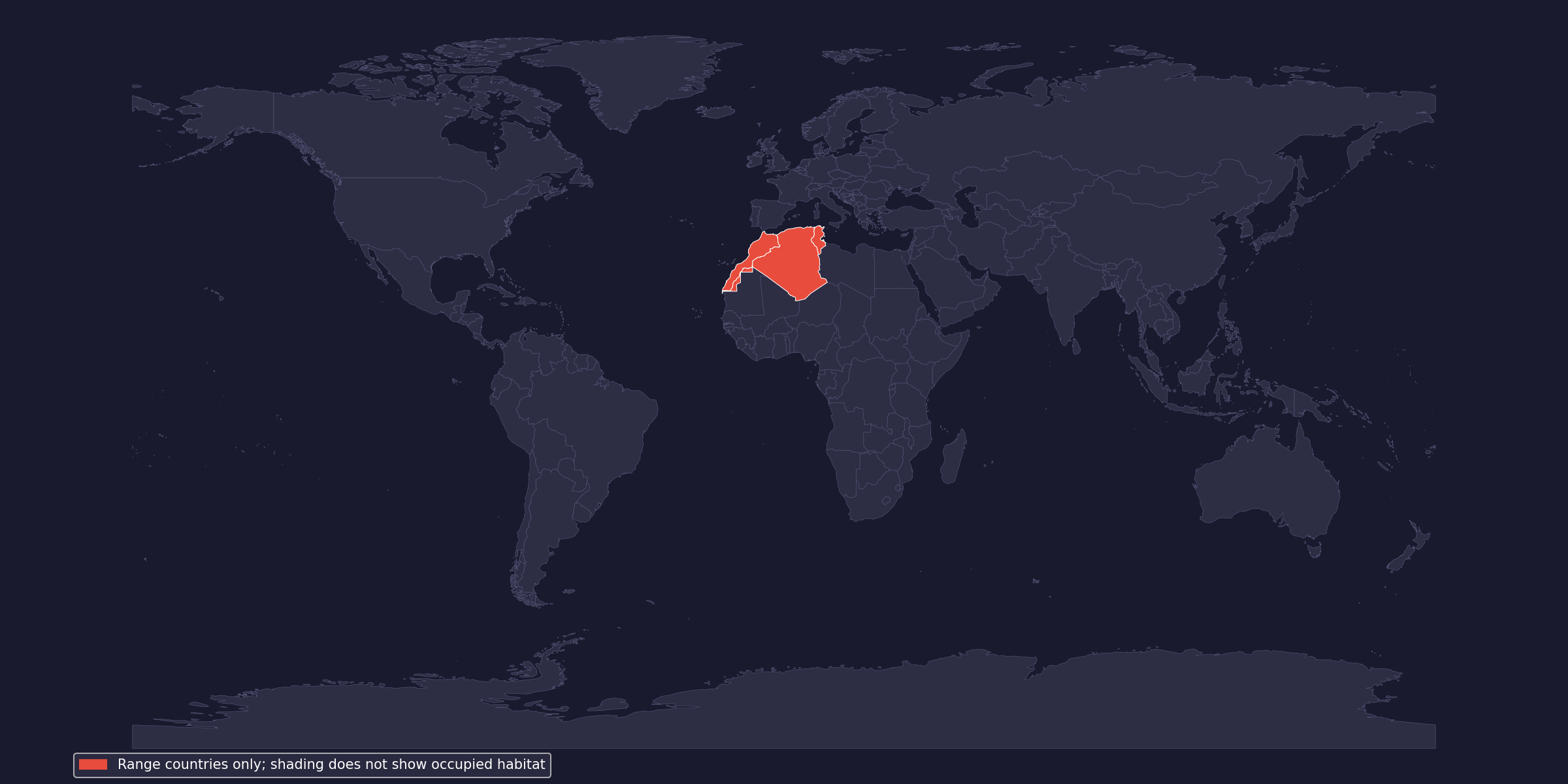
Morocco, Western Sahara, northern Algeria and Tunisia. Rocky slopes, scrub and agricultural edges are more useful husbandry context than the word “Sahara”: this is not a snake for an enclosure filled with uniformly hot, loose dune sand. The map shows countries and territories, not continuous occupied habitat.
🌡 Climate across the native range
Regional outdoor normals show seasonality, not enclosure settings. These representative settlement coordinates are not exact snake localities.
Marrakesh — Morocco
| Month | Min °C | Mean °C | Max °C | RH % |
|---|---|---|---|---|
| January | 3.1 | 9.9 | 17.6 | 71 |
| February | 4.6 | 11.6 | 19.3 | 67 |
| March | 7.1 | 14.5 | 22.2 | 63 |
| April | 9.5 | 16.8 | 24.1 | 62 |
| May | 12.5 | 20.2 | 27.8 | 56 |
| June | 15.7 | 24 | 32 | 52 |
| July | 18.4 | 27.4 | 36 | 47 |
| August | 19 | 27.4 | 35.8 | 49 |
| September | 16.4 | 23.5 | 31.1 | 56 |
| October | 12.8 | 19.7 | 27 | 60 |
| November | 7.7 | 14.4 | 21.7 | 66 |
| December | 4.5 | 11.1 | 18.7 | 71 |
Weather data by Open-Meteo.com · CC BY 4.0 · Monthly normals calculated by Herpeton Academy from daily archive values.
⚖️ Legal status
No CITES or specific EU wildlife-trade annex listing was found under the accepted name or relevant older combinations.
Bern Convention scope needs care: Appendix III covers reptiles not in Appendix II, but the historical Vipera lebetina entry in Appendix II complicates interpretation of old mauritanica records. The precise treaty treatment remains uncertain; obtain the competent authority’s interpretation where the treaty applies.
Legal review: 17 September 2026. National capture, possession, registration, breeding, sale and transport rules may be stricter. Verify permits before transfer and keep invoices, breeder identity, parentage and import records. Trade status does not itself authorize keeping a venomous snake.
🤌 Husbandry
Keep Daboia mauritanica individually in a locked enclosure within an access-controlled venomous-reptile room. Secondary containment and a lockable shift compartment should permit water changes and cleaning only after the animal has been isolated and visually accounted for. Free-handling is unacceptable. Prepare written bite and escape plans, trained backup cover and a veterinary arrangement before acquisition.
Quarantine for at least 90 days as a working minimum, longer when the veterinarian advises. Use separate tools and a simple enclosure; record feeding, sheds, faeces and body condition. Arrange parasite screening for uncertain-origin animals or abnormal stools. Weigh only through an established protected-contact procedure.
💡 Lighting
Provide about 12-14 hours of visible light during the active season, with darkness at night and shaded retreats. A species-specific UVB requirement has not been demonstrated. If low-level UVB is used, measure exposure and retain complete shade; do not infer lamp strength from desert photographs. Guard lamps and wiring against contact.
🌡 Heating and temperature
Begin with air at 24-28°C, a local basking surface at 31-33°C, a cool retreat at 21-24°C and night air at 18-22°C. These are cautious working bands, not tolerance limits. Measure air, surface and cool-hide temperatures separately. Thermostat-control heating; check the room during summer because a thermostat cannot cool hot air.
Seasonal cooling requires a documented, locality-specific plan for healthy, established adults. Do not cool new arrivals, thin, sick or gravid animals, or copy an adult breeding cycle onto juveniles. Outdoor monthly normals are not brumation instructions.
💧 Humidity and water
Use 40-60% relative humidity as an initial management band, with ventilation and a mostly dry resting surface. Provide a small locally moist retreat during shedding without wetting the whole enclosure. Offer clean drinking water continuously in a stable, shallow bowl, serviced through the protected system. Dry habitat does not mean absence of water. Persistent condensation or repeated retained sheds needs review; never peel skin or force soaking.
🌿 Enclosure and decoration
Use at least the practical 180 × 80 × 70 cm layout in the table and allow the snake to stretch fully. Check door gaps, vents and cable holes against the smallest animal housed. Fix rocks directly to the enclosure base so excavation cannot undermine them; retain clear sightlines to shift doors. Avoid sharp gravel, aromatic wood and unstable piles. Remove waste after securing the snake.
After quarantine, use about 5-8 cm of compactable soil mixed with washed sand, mostly dry at the surface, with stable low stone cover. Paper is easier to inspect during quarantine.
🐁 Feeding
Established adults can take appropriately sized thawed whole rodents. Begin with a modest mouse or small rat no wider than the thickest body section; the large head does not justify oversized meals. Juveniles need smaller meals, usually every 7-10 days, with the breeder’s feeding record retained.
The table gives an initial adult feeding interval of 14-21 days; adjust portions and timing to weight trend and condition. Deliver food through the collection’s protected feeding system. Avoid live rodents and substrate-coated food; dehydration, low temperatures and oversized meals increase regurgitation and impaction concerns. Whole prey normally needs no routine calcium or vitamin dusting. Do not improvise supplementation or force-feeding.
🥚 Breeding
This species lays eggs, unlike Asian Russell’s vipers. Weima (1990) incubated one clutch at 25-29°C; the first young hatched about 49-50 days after laying. These are single-report outcomes, not guaranteed incubation limits. Obtain a successful protocol for the parental line before pairing. Have sex confirmed professionally and assess maturity, condition and recovery rather than relying on a universal age.
Breeding adds exposure risk. Prepare separate, escape-proof neonatal housing before pairing, avoid permanent cohabitation, and retain parentage, dates, meals and transfer records. Only breed when lawful placements and competent staff are available.
🩺 Common problems
- Overheating: repeated escape attempts or unusual exposed resting require immediate measurement of the cool retreat.
- Dysecdysis and dehydration: review drinking access and the moist refuge; repeated problems need veterinary assessment.
- Respiratory infection or stomatitis: wheezing, bubbles or oral discharge require prompt professional care.
- Dermatitis, impaction, obesity and parasites: dirty wet bedding, substrate ingestion, excessive feeding or persistent weight loss need correction and diagnosis. Do not use automatic deworming or home restraint.
📌 Conclusion
For a Moorish viper, the decisive requirements are room for a large adult and verified North African provenance. Do not accept a small enclosure or an unresolved antivenom plan merely because the animal feeds readily.
📚 Sources and further reading
ReptiFiles was checked first on 17 September 2026; no species-specific guide was found. Numerical recommendations are separated from directly reported breeding outcomes. Historical care reports are not current medical instructions.
- Reptile Database
- GBIF
- Weima (1990): breeding report
- Daboia venom variation
- Moroccan venom and antivenom study
- ReptiFiles
- WHO: snakebite first aid
- CITES Appendices — 5 March 2026
- EU Regulation 2026/1383
- Bern Convention Appendix II
- Bern Convention Appendix III
- DAERA: venomous-snake keeping guidance
- Baines et al. (2016): UV-Tool