Share

Rhombic Night Adder
🔤 Taxonomy
The rhombic night adder is Causus rhombeatus, an egg-laying African viper in Viperidae. Older combinations include Aspidelaps rhombeatus and Sepedon rhombeata; some western records and older care notes instead concern Causus maculatus.
📌 Description
Rhombic Night Adder is a small terrestrial viper with specialized amphibian feeding. Adults are usually 30-60 cm and a well-managed animal may live 10-15 years. Unlike many vipers it is relatively slender, lays eggs and often actively searches for amphibians. Its common name is misleading because activity is not strictly nocturnal.
Its venomous bite can cause serious injury and requires urgent hospital assessment. This guide is written for licensed zoological institutions and legally authorized specialists with protected-contact training. The animal is display-only: free handling, public encounters and casual hook demonstrations are incompatible with responsible care.
| Quick reference | Practical target |
|---|---|
| Adult size | 30-60 cm |
| Adult enclosure | At least 90 x 50 x 45 cm, with a lockable shift compartment |
| Temperature | Air 23-28°C; warm site 29-31°C; cool zone 21-24°C |
| Night | 19-23°C |
| Humidity | 50-70%, locally 70-80% for shedding |
| Feeding | 7-14 day interval, adjusted to age and body condition |
| Safety | Double containment, protected service, escape plan and hospital-coordinated bite plan |
☠️ Venom
This species is venomous. Venom exposure can cause pain, swelling or other systemic effects, and severity varies with species, locality, bite site and the amount delivered. A small wound or apparently dry bite is not proof of safety; every bite or sting requires urgent medical assessment.
If an incident occurs, move away, call emergency services or a poison centre, keep the patient still, remove rings and other constricting items, and follow dispatcher instructions. Do not use a tourniquet, cut or suck the wound, apply ice or electricity, give alcohol or medicines as a home treatment, or attempt to catch the animal. Antivenom choice and dosing are hospital decisions; verify the relevant product and local availability in advance. Sources: WHO snakebite guidance and appropriate species-specific toxinology or medical references listed below.
🌍 Distribution
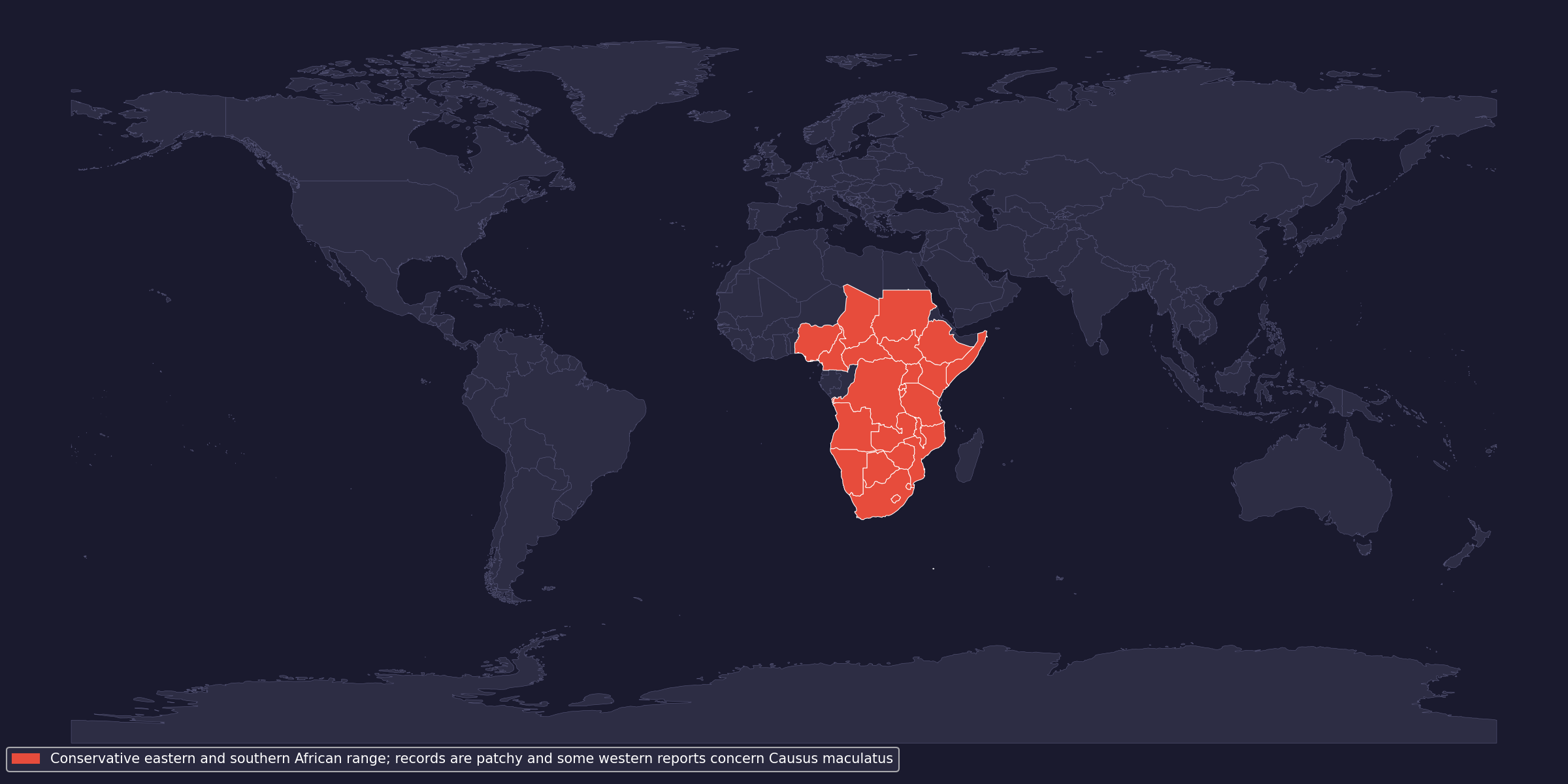
The current range is eastern and southern sub-Saharan Africa. It occupies moist savanna, grassland, woodland edge, agricultural mosaics and wetland margins. Country-level shading is deliberately conservative and cannot show the small, fragmented or elevational limits within each country.
The useful captive lesson is to provide measured choices rather than reproduce outdoor averages: a warm retreat, a cooler protected area, ventilation, clean water and cover must remain available simultaneously.
⚖️ Legal status
Status checked on 4 September 2026: No current CITES or EU annex listing was found, and Bern is not relevant to its African range. Dangerous-animal, wildlife, import and transport laws can still apply. The Bern Convention is not relevant because the species is not native to Europe.
Ownership, registration, breeding, sale, transport, import and emergency-plan rules remain country-dependent. Obtain written confirmation from the competent authority before acquisition. Keep the invoice, breeder or importer details, scientific name, locality and parentage, photographs, transfer records and all CITES or import documents for the animal’s lifetime.
🤌 Husbandry
House one animal per enclosure inside a locked, access-controlled venomous room with secondary containment. Provide two secure retreats, one operating as a shift compartment behind a tool-operated door. Water, waste and routine maintenance must be accessible only after the keeper has positively confirmed and secured the animal.
Quarantine for at least 90 days with simple furnishings and dedicated tools, preferably in separate airspace. Record weight, meals, waste, sheds, respiration and behaviour. Imported or uncertain-origin animals need an experienced reptile veterinarian and parasite assessment. A second trained adult should be present for any non-routine access.
💡 Lighting
Provide 10-12 hours of broad visible light and complete darkness at night. Low-output UVB may be offered as a measured Ferguson Zone 1 opportunity, with full shade at the same temperature. Whole-prey nutrition does not make intense UVB appropriate.
Install lamps, cables and emitters outside the enclosure or behind rigid guards. Measure UV at the actual resting position and replace lamps according to measured output, not colour or apparent brightness.
🌡 Heating and temperature
Maintain daytime air at 23-28°C, a limited warm site at 29-31°C and a cool retreat at 21-24°C. Night temperatures may fall to 19-23°C. The animal must be able to leave the heated area without crossing an exposed service zone.
Control every heater with a thermostat and use independent probes at warm, cool and occupied levels. An alarm for high temperature is essential. Heat rocks, unguarded lamps and powerful overhead emitters can cause burns or fatal overheating.
💧 Humidity and water
Use 50-70% RH as a working range and provide a sheltered microclimate around 70-80% during shedding. Humidity must not mean a continuously wet floor. Let exposed surfaces dry, preserve airflow and judge the setup by hydration, clean sheds and skin condition.
Supply a stable bowl of fresh water from a protected service point. Persistent condensation, sour substrate, mould or wet ventral skin indicates excessive moisture or inadequate ventilation.
🌿 Enclosure and decoration
One adult needs at least 90 x 50 x 45 cm; larger individuals need enough additional room to turn, travel and use every thermal zone. Use 8-12 cm of compactable soil and leaf litter with a moist hide but a dry surface option. Paper is safer during quarantine.
All furnishings must be fixed, visible during an animal count and compatible with the shift route. Avoid adhesive décor, sharp mesh, unstable rocks or branches, aromatic wood and inaccessible cavities. Each opening needs an independent mechanical lock and neonate-proof ventilation.
🪳 Feeding
Offer a nutritionally planned whole-prey programme developed with an experienced institution; many individuals strongly prefer amphibians. Do not collect wild amphibians or improvise force-feeding. Captive-bred origin and a proven, lawful feeding history should be prerequisites to acquisition. Use feeding tongs only after the animal is secured in a known position; never hand-feed or leave live vertebrate prey unattended.
Whole prey normally supplies calcium and vitamins without dusting. Regurgitation, repeated refusal or weight change requires a review of prey size, temperature, disturbance and disease rather than repeated feeding attempts.
🛡 Operational safety and emergencies
Written procedures must cover shifting, feeding, cleaning, veterinary transport, escape and fire. Label the enclosure with scientific name, individual count, venom hazard, emergency contacts and bite-plan location. Inventory the animal at every door transition.
Before acquisition, agree a species-specific response with the receiving hospital or poison centre. After a bite call emergency services, keep the patient still, remove constricting items and follow poison-centre instructions. Do not cut, suck, ice, electrically shock or tightly tourniquet the wound, and do not delay transport to catch the animal.
🥚 Breeding notes
Egg laying is documented, but breeding belongs only in established institutional programmes. Reported clutches are commonly 6-20; a conservative incubation starting range is 24-27°C for roughly 60-90 days. These are not guarantees: incubator gradients, egg condition and provenance matter. Never cycle a thin, ill, newly imported or unproven animal.
🩺 Common problems
Important risks include refusal of unsuitable prey, parasite burden in imports, dehydration, dermatitis, respiratory disease and stress from exposed housing. Refusal or immobility alone is not a diagnosis. Secure the animal before investigation, verify recorded temperatures and humidity, and arrange protected examination by an experienced reptile veterinarian. Never attempt hands-on home restraint or treatment.
📌 Conclusion
Rhombic Night Adder belongs only in a legal specialist programme that already has double containment, a reliable shift system, species-appropriate climate control and a hospital-ready emergency plan. Acquisition should follow—not precede—proof that those systems work.
📚 Sources and further reading
- The Reptile Database — Causus rhombeatus
- GBIF species record
- WHO snakebite-envenoming resources
- CITES Appendices
- Commission Regulation (EU) 2026/1383
- Baines et al. (2016), reptile UVB guidance