Share

Brown Tree Snake
🔤 Taxonomy
Boiga irregularis is the accepted name for the brown tree snake, a rear-fanged arboreal colubrid. Older literature may use Boiga fusca. Locality is important: the species is native across parts of Australia, New Guinea and Pacific islands, but the Guam population is introduced and has caused severe ecological damage.
📌 Description
A slender adult is commonly 100-200 cm long and may live 12-20 years. This is an alert nocturnal display snake, not a handling animal. Most human bites cause limited effects, but prolonged chewing increases venom delivery and systemic reactions have occurred, especially in small children. Its climbing ability and invasive history make escape prevention central to welfare and public safety.
| Enclosure and decoration | 120 × 60 × 120 cm |
| Heating and temperature | 25-29°C; basking 30-32°C |
| Humidity and water | 60-80% |
| Feeding | 7-14 days |
☠️ Venom
This species is venomous. Venom exposure can cause pain, swelling or other systemic effects, and severity varies with species, locality, bite site and the amount delivered. A small wound or apparently dry bite is not proof of safety; every bite or sting requires urgent medical assessment.
If an incident occurs, move away, call emergency services or a poison centre, keep the patient still, remove rings and other constricting items, and follow dispatcher instructions. Do not use a tourniquet, cut or suck the wound, apply ice or electricity, give alcohol or medicines as a home treatment, or attempt to catch the animal. Antivenom choice and dosing are hospital decisions; verify the relevant product and local availability in advance. Sources: WHO snakebite guidance and appropriate species-specific toxinology or medical references listed below.
🌍 Distribution
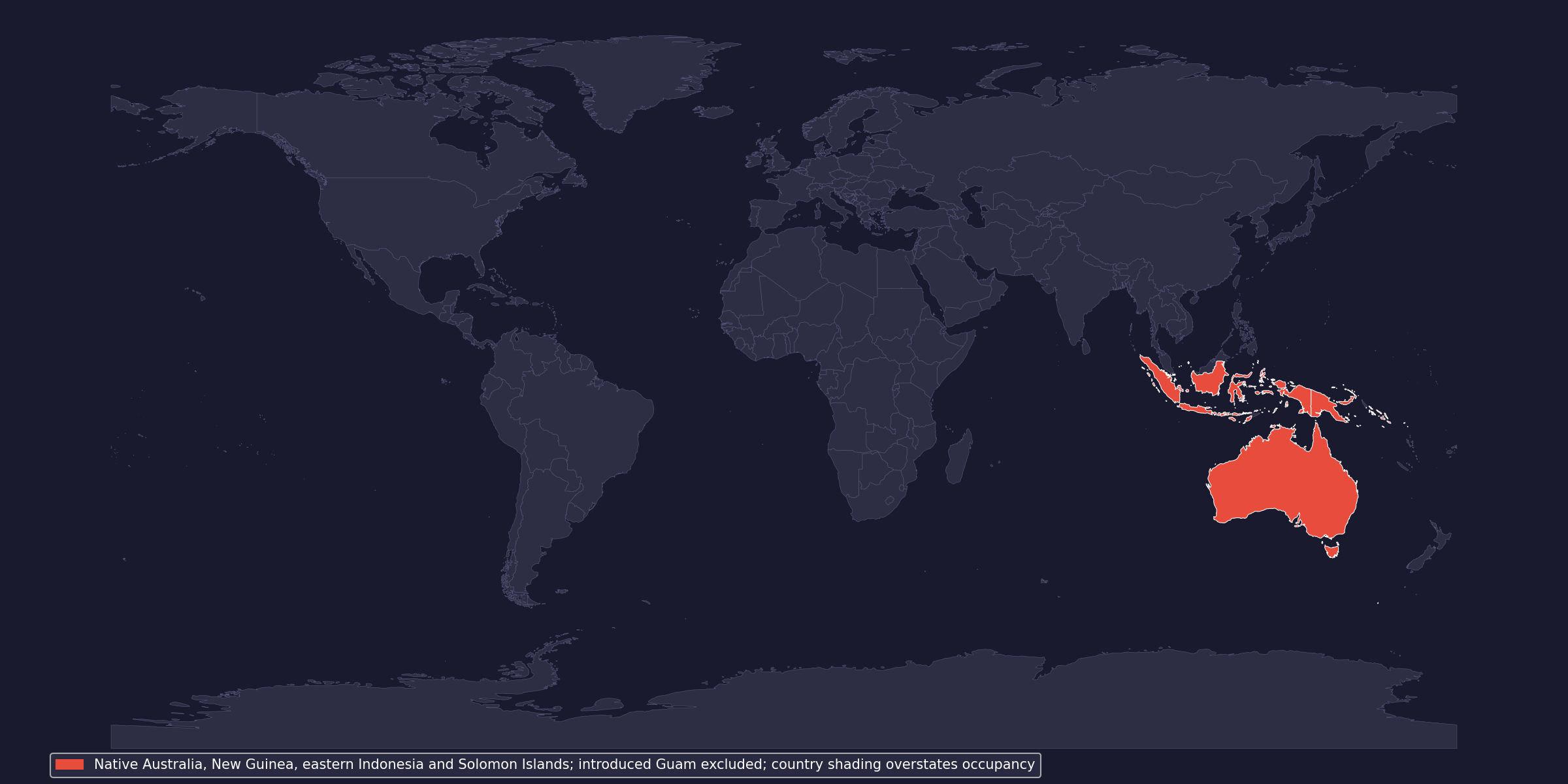
The native range includes northern and eastern Australia, parts of eastern Indonesia, Papua New Guinea and the Solomon Islands. Guam is an introduced range and must not be shown as native; Micronesia is not part of the native range. The snake uses forest, woodland, caves, buildings and disturbed vegetation, resting in narrow elevated refuges by day.
⚖️ Legal status
The species is not currently CITES-listed and no specific EU wildlife-trade annex listing was found at the September 2026 check. That does not make ownership unrestricted. Rear-fanged or dangerous-animal rules, invasive-species controls, import law and transport restrictions may apply. Guam and other Pacific jurisdictions apply particularly strict biosecurity measures. Never release or move an undocumented animal between regions.
The Bern Convention is not relevant because this species is not native to Europe. Local and national ownership, registration, transport, breeding and sale rules may still apply.
🤌 Husbandry
House singly. Use a lockable front-opening enclosure with a shift box, removable water and branches that can be serviced while the snake is isolated. Quarantine new or imported animals for at least 60-90 days with paper substrate, separate tools, weight and faecal records, and veterinary parasite testing where origin is uncertain.
💡 Lighting
Provide an 11-13 hour day-night cycle and darkness at night. Low-level UVB is optional but beneficial when measured and paired with shade. Bright visible light over live plants helps establish a clear daytime resting period without exposing the snake at all times.
🌡 Heating and temperature
Use 25-29°C ambient air, a 30-32°C basking surface, a 23-25°C cool retreat and 22-25°C nights. Thermostat every heater and verify elevated perches as well as hides; heat accumulates near the enclosure roof.
- 25-29°C
- basking: 30-32°C
- cool: 23-25°C
- night: 22-25°C
💧 Humidity and water
Maintain a ventilated 60-80% range and a humid hide reaching 75-90% during shedding. Keep fresh water available in a bowl removable from outside or after shifting. Wet stagnant substrate is not a substitute for humidity and encourages skin and respiratory problems.
🌿 Enclosure and decoration
For an average adult provide at least 120 × 60 × 120 cm, enlarged when the snake cannot stretch or travel normally. Add anchored crossing branches, cork tubes, dense visual cover and several snug elevated refuges. Use about 8-10 cm of well-drained soil-based substrate after quarantine. Seal cable holes and use redundant locks: this species can bridge gaps and exploit small openings.
🐍 Feeding
Offer appropriately sized frozen-thawed rodents, chicks or other legally sourced whole prey every 7-14 days, adjusted to age and condition. Some new arrivals prefer birds or lizards and require gradual scent transition rather than live prey. Feed through a protected routine and never hold prey by hand.
🛡 Operational safety
Treat the animal as display-only. Use a hook, shield and shift box rather than free handling. After a bite, disengage without pulling against embedded teeth, wash the site, remove rings and seek poison-centre or medical advice for prolonged chewing, swelling, weakness, breathing changes or any bite to a child. Do not cut, suck, ice or tourniquet the wound.
🥚 Breeding
Females lay roughly 4-12 eggs. Captive reports use approximately 27-29°C with hatching often around 60-90 days, but locality and true egg temperature matter. Breeding is difficult because secure neonatal housing, documented placement and invasive-species law must be arranged before eggs are produced.
🩺 Common problems
Common failures are escape, rostral abrasions, refusal after import, prey-borne parasites, mites, dehydration, retained shed, obesity and respiratory infection from cool stagnant dampness. Repeated refusal, wheezing, open-mouth breathing or loss of coordination warrants an experienced reptile veterinarian.
📌 Conclusion
The brown tree snake suits an advanced display keeper only where possession and biosecurity are lawful. A shiftable, escape-proof enclosure and a no-release plan are more important than decorative planting.