Share

West African Bush Viper
🔤 Taxonomy
Atheris chlorechis is the West African bush viper. Vipera chlorechis is its original combination, and chloroechis appears as an older spelling. “Green bush viper” is also applied to A. squamigera: obtain a species-level identification rather than buying by colour or that common name.
📌 Description
A slender climbing viper, often green with pale spotting, approximately 40–70 cm for adult enclosure planning. Its lowland forest background calls for warmer conditions than montane congeners, while ventilation and shaded retreats remain essential. Published human bites demonstrate that its modest size does not imply mild venom.
The Atheris squamigera guide offers a comparison for perching, ventilation and hydration. The provisional numerical targets here are adjusted to this species’ documented habitat; they are not a tested species-specific protocol or measured tolerance limits. Broadley’s review supports the natural-history rationale, not validation of these terrarium values. Enclosure sizes are practical recommendations. Reliable species-specific lifespan and maturity schedules are lacking; retain age, growth and health records instead of promising a fixed lifespan.
📋 Quick reference
| Care point | Provisional active-season target |
|---|---|
| Adult length | 40–70 cm |
| One adult enclosure | 75 × 60 × 90 cm |
| Ambient air | 23–27°C |
| Basking surface | 28–29°C |
| Cool retreat | 21–24°C |
| Night air | 20–23°C |
| Relative humidity | 65–85% |
🌍 Distribution
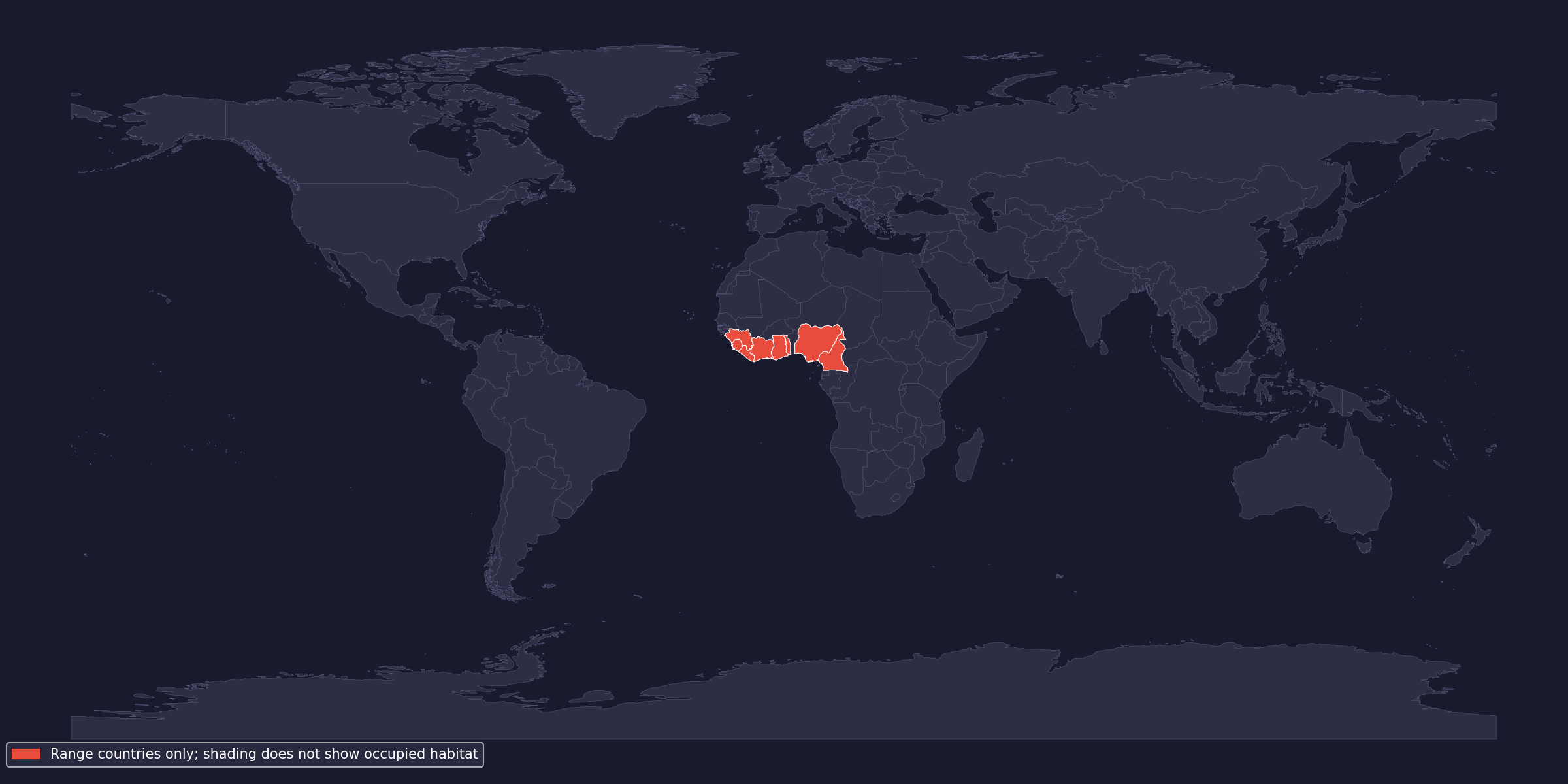
The current Reptile Database lists Guinea, Sierra Leone, Liberia, Ivory Coast, Ghana, Togo, Nigeria and Cameroon; Benin is noted as probable rather than confirmed. Forest habitat is fragmented, not continuous across the shaded countries. Lowland points in Ghana and Liberia illustrate regional differences; neither is a verified snake observation.
🌡 Climate across the native range
Reference period: 1991–2020. Outdoor normals for representative habitat terrain, not verified snake observations or terrarium settings.
Southwestern forest belt — Ghana
| Month | Min °C | Mean °C | Max °C | RH % |
|---|---|---|---|---|
| January | 23.6 | 26.1 | 29.8 | 85 |
| February | 24.5 | 26.6 | 30 | 86 |
| March | 24.6 | 26.7 | 30 | 87 |
| April | 24.4 | 26.6 | 29.7 | 88 |
| May | 23.8 | 25.9 | 28.8 | 89 |
| June | 23.1 | 24.8 | 27.3 | 90 |
| July | 22.7 | 24.2 | 26.5 | 87 |
| August | 22.5 | 24 | 26.3 | 88 |
| September | 22.8 | 24.4 | 27 | 89 |
| October | 23 | 24.9 | 27.9 | 89 |
| November | 23.2 | 25.5 | 29 | 89 |
| December | 23.5 | 25.9 | 29.3 | 88 |
Interior forest belt — Liberia
| Month | Min °C | Mean °C | Max °C | RH % |
|---|---|---|---|---|
| January | 21.8 | 25.4 | 30.6 | 76 |
| February | 22.6 | 25.8 | 31 | 79 |
| March | 22.6 | 25.5 | 30.3 | 84 |
| April | 22.5 | 25.3 | 30 | 86 |
| May | 22.3 | 25 | 29.4 | 87 |
| June | 21.7 | 24 | 28.1 | 87 |
| July | 21.3 | 23.5 | 27.2 | 85 |
| August | 21.3 | 23.4 | 27 | 86 |
| September | 21.6 | 23.7 | 27.8 | 88 |
| October | 21.7 | 24.2 | 28.7 | 87 |
| November | 21.6 | 24.5 | 28.9 | 87 |
| December | 21.6 | 24.8 | 29.3 | 83 |
Weather data by Open-Meteo.com · CC BY 4.0 · Monthly normals calculated by Herpeton Academy from daily archive values.
⚖️ Legal status
Checked 17 September 2026: the reviewed official CITES Appendices and EU wildlife-trade annexes do not list this species. Bern is not relevant to its native African range. Non-listing does not authorize capture, export or ownership: check national wildlife controls in the country of origin and local rules at the destination for dangerous animals, import, registration, breeding, transport and sale. Retain breeder identity, invoice, parentage and any export/import documents.
☠️ Venom
A 2026 clinical report describes severe consumption coagulopathy, microvascular injury and local necrosis, without demonstrated benefit from Inoserp Pan-Africa in that case.
A bite is a medical emergency. Severity varies between bites. Pain, swelling, tissue injury and serious clotting disturbance or bleeding are possible; a small snake or an apparently dry bite is not reassuring. No Atheris-specific antivenom was identified in the reviewed clinical literature. Products for other vipers cannot be assumed effective.
Move away, call emergency services, remove tight items, keep the patient still and support the limb without compression. Do not cut, suck, ice or tourniquet the wound, or delay transport to capture the snake. Agree a receiving hospital and poison-centre pathway before acquisition; treatment decisions belong to those clinicians.
🤌 Husbandry
Keep one animal per locked enclosure inside a locked, access-controlled room with secondary containment. Use a shift compartment that permits isolation and visual confirmation before servicing; never free-handle. Written bite and escape plans, trained backup staff and a reptile veterinarian are prerequisites.
Quarantine separately for at least 90 days as a working minimum, extending it on veterinary advice. Use paper substrate and dedicated tools; record meals, weight or body condition, stools and sheds. Arrange parasite screening for uncertain origin, weight loss or abnormal faeces. Any examination or weighing must use an established protected-contact procedure.
💡 Lighting
Use a timer for 11–13 hours of visible light and a dark night, with shaded resting sites available throughout. No precise species-specific UVB requirement was verified. If low-level UVB is used, measure exposure, retain opaque cover and have the arrangement reviewed by the collection veterinarian; lamp output is not interchangeable with a UVI measured at the perch.
🌡 Heating and temperature
Offer the warm perch at one upper side, with equally usable shaded branches away from it. Avoid copying the colder mountain-viper nights: this is a lowland forest species. Conversely, a warm room plus a lamp can eliminate the cool zone, so monitor the shaded canopy as well as the basking point.
Thermostat-control and guard every heat source. Measure air and perch surfaces separately, including the coolest usable perch. Test the room through summer: a thermostat cannot cool it. These tropical vipers have no routine cold-brumation instruction here. Any breeding-season change must follow a documented locality-specific protocol for healthy established adults, never automatic cooling of juveniles, gravid, thin, sick or newly arrived animals.
💧 Humidity and water
Treat the humidity band as a provisional daily management range, allowing rises after misting and drying between cycles. Briefly wet selected leaves to offer droplets, while also providing a stable clean water bowl. Observe drinking from outside the enclosure; do not assume a bowl alone or constant spraying guarantees hydration.
Ventilate across the enclosure and leave dry perches available. Persistent condensation or wet belly scales calls for a drainage and airflow review, not more heat everywhere. Never force soaking or peel retained skin; recurrent shedding difficulty needs veterinary assessment.
🌿 Enclosure and decoration
Build a network of crossing branches and leafy cover that lets the snake move horizontally without descending onto an exposed floor. Leave more than one dry resting fork after misting. Secure plants so that cleaning or an animal’s weight cannot pull a branch against the door gap.
After quarantine, about 5–8 cm of fertiliser-free soil mixed with fine bark or coir can buffer moisture above a drainable base. Keep the resting surface clean rather than saturated; paper remains useful for juveniles and observation. Avoid sharp gravel, dusty sand and aromatic wood. Keep prey free of substrate: swallowed particles, dehydration and oversized meals can contribute to impaction. Anchor all branches independently of loose soil and check for neonatal escape gaps.
🐁 Feeding
Natural-history records include small mammals. For a reliably established animal, offer a modest thawed whole mouse roughly every 14–21 days; juveniles need smaller prey, often every 7–10 days. These are starting intervals, not a reason to feed a sedentary adult whenever it strikes. Record body condition and ask the source keeper about any earlier prey transitions.
For vertebrate prey, start no wider than the snake’s widest body section; whole prey normally needs no routine vitamin or calcium dusting. Avoid live rodents and feeding disturbance. Never attempt force-feeding at home. Persistent refusal with weight loss, regurgitation or mouth discharge needs diagnosis rather than progressively larger meals.
🥚 Breeding
This is a live-bearing species; there is no egg-incubation schedule. Males often have relatively longer tails, but visual clues are not sufficient for a breeding decision: have sex confirmed through a professional protected procedure. Reliable universal maturity ages are not established; use documented age, adult size, body condition and the source institution’s records.
Pair only healthy mature animals of compatible documented locality under a specialist plan. Gestation and recovery can be costly for small females, so do not assume annual breeding is appropriate. Prepare separate locked neonatal housing, feeding expertise and lawful placements before pairing. Keep records of parentage, births, sheds and first meals.
🩺 Common problems
- Overheating: unusual exposed resting or repeated escape attempts warrant immediate checks of the cool hide and room.
- Respiratory infection: bubbles, wheezing or open-mouth breathing need prompt reptile-veterinary assessment.
- Dysecdysis, dehydration and dermatitis: check water access, refuge moisture and wet dirty substrate; do not manually strip skin.
- Obesity, impaction or parasites: track meals, stools and body condition; persistent change needs diagnosis.
- Reproductive problems: prolonged abnormal swelling, weakness or unsuccessful birth requires urgent veterinary advice.
📌 Conclusion
This lowland forest viper needs warm, ventilated climbing space and a credible hospital plan. Its green colour and modest length should never lower the containment standard.
📚 Sources and further reading
ReptiFiles was searched first on 17 September 2026; no species-specific guide was found. Distribution and taxonomic references establish natural-history context, not tested terrarium targets. The official keeping guidance supports containment; numerical care values are explicitly provisional. Venom studies support caution, not an antivenom recommendation.
- Reptile Database: Atheris chlorechis
- GBIF: Atheris chlorechis
- ReptiFiles
- Broadley (1998): Atheris taxonomy, habitat, size and diet
- Atheris procoagulant venom and antivenom research (2022)
- A. chlorechis clinical case (2026)
- A. nitschei envenomation account
- WHO: snakebite first aid
- Official guidance on keeping venomous snakes
- UV-Tool (Baines et al. 2016)
- CITES Appendices, 5 March 2026
- EU wildlife-trade annexes, Regulation 2026/1383