Share

Asian Vine Snake
🔤 Taxonomy
Ahaetulla prasina is the accepted name for the Asian vine snake or Oriental whip snake. Older material may list Dryophis prasinus or Passerita prasina. Several named subspecies and a broad variable range make documented locality useful, while recent revisions mean Indian vine snakes once casually assigned to this name may represent other species.
📌 Description
This extremely slender, forward-looking, diurnal snake reaches about 120-180 cm but has little body mass. It is mildly venomous and rear-fanged; bites are uncommon but deliberate handling is unnecessary. The real husbandry difficulty is feeding and acclimation: many imports arrive dehydrated, stressed and committed to lizard or frog prey.
| Enclosure and decoration | 120 × 60 × 120 cm |
| Heating and temperature | 25-29°C; basking 30-32°C |
| Humidity and water | 60-80% |
| Feeding | 5-10 days |
☠️ Venom
This species is venomous. Venom exposure can cause pain, swelling or other systemic effects, and severity varies with species, locality, bite site and the amount delivered. A small wound or apparently dry bite is not proof of safety; every bite or sting requires urgent medical assessment.
If an incident occurs, move away, call emergency services or a poison centre, keep the patient still, remove rings and other constricting items, and follow dispatcher instructions. Do not use a tourniquet, cut or suck the wound, apply ice or electricity, give alcohol or medicines as a home treatment, or attempt to catch the animal. Antivenom choice and dosing are hospital decisions; verify the relevant product and local availability in advance. Sources: WHO snakebite guidance and appropriate species-specific toxinology or medical references listed below.
🌍 Distribution
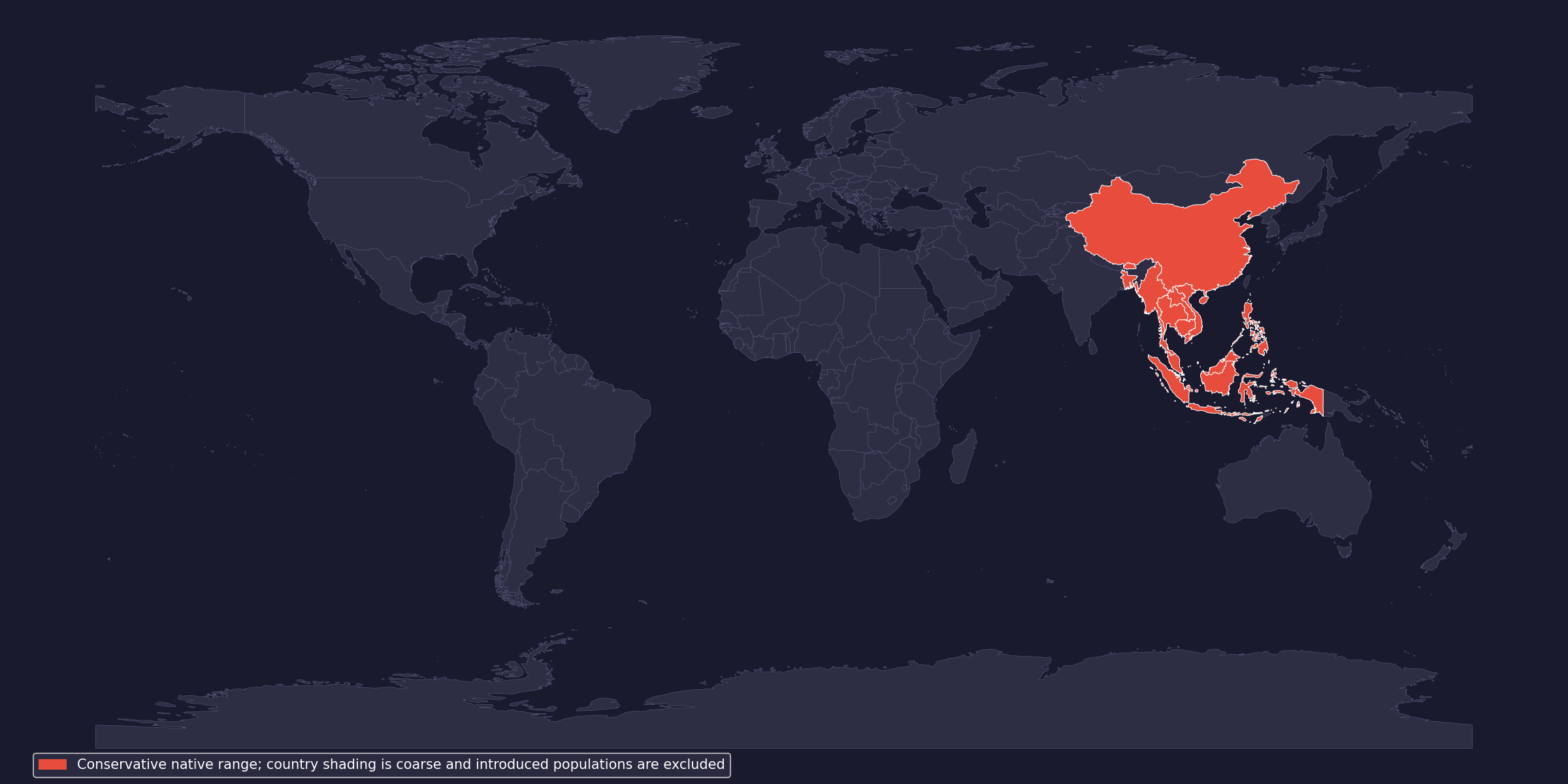
The accepted range extends from Myanmar, Bangladesh and Bhutan through southern China and mainland Southeast Asia to Malaysia, Singapore, Indonesia, Brunei and parts of the Philippines. It occupies shrubs, forest edges, gardens and layered canopy vegetation. The broad country map cannot represent subspecies boundaries, island absences or recent exclusions from India.
⚖️ Legal status
The species is not currently listed by CITES, and no specific EU wildlife-trade annex or Bern Convention listing was found at the September 2026 check. National wildlife export, import, rear-fanged-snake and animal-welfare rules still apply. Because wild-caught trade creates feeding and parasite problems, obtain documented captive-bred animals and retain invoices and origin records.
The Bern Convention is not relevant because this species is not native to Europe. Local and national ownership, registration, transport, breeding and sale rules may still apply.
🤌 Husbandry
House singly in a quiet room. Quarantine in a simple but vertically furnished enclosure with visual barriers, elevated hides and separate tools. Record weight, drinking, faeces and every offered prey item. Avoid repeated handling and exposed glass on all sides; chronic visibility and keeper traffic commonly suppress feeding.
💡 Lighting
This is a diurnal visual hunter. Provide bright full-spectrum light for 11-13 hours and measured UVB in Ferguson Zone 2 over part of the upper canopy. Create dense shade at the same temperature range so the snake can choose exposure. All lamps must be guarded from the animal’s long body.
🌡 Heating and temperature
Maintain 25-29°C ambient air, a 30-32°C basking branch, a 23-25°C cool retreat and nights of 21-24°C. Measure branch surfaces and upper air, not only the floor. Persistent high heat without shade dehydrates this very slender snake quickly.
- 25-29°C
- basking: 30-32°C
- cool: 23-25°C
- night: 21-24°C
💧 Humidity and water
Aim for 60-80% humidity, rising locally to 75-90% during shedding, with daily drying and strong airflow. Provide a clean elevated water cup and droplets on foliage, because some new arrivals recognize moving droplets more readily than a floor bowl. Never allow constant condensation or saturated substrate.
🌿 Enclosure and decoration
Provide at least 120 × 60 × 120 cm for one adult, with a larger footprint for a long individual. Build a network of thin and medium branches across several heights, dense foliage, cork retreats and unobstructed basking routes. After quarantine use 6-8 cm of well-drained soil and leaf litter. Front openings need locks and cable gaps must be sealed.
🐍 Feeding
Many individuals specialize on lizards and frogs. A documented captive-bred animal already taking frozen-thawed prey is strongly preferable. Offer small whole prey every 5-10 days, keeping prey narrow enough for the snake’s delicate build. Transition with scenting and patience; do not use wild amphibians, and do not force routine live feeding or repeated manual feeding.
🛡 Operational safety
Keep as a display animal and use a hook or removable perch for transfers. A bite should be allowed to release without pulling, then washed and observed. Seek medical advice for progressive swelling, systemic symptoms, prolonged chewing or a bite to a child. Do not cut, suck, ice or tourniquet the wound.
🥚 Breeding
The species is ovoviviparous and should be represented in metadata as viviparous: females give birth to live young, commonly reported in litters of about 4-12. Breeding should use stable, feeding adults of known locality. Prepare individual planted juvenile enclosures and a reliable supply of very small legal prey before pairing.
🩺 Common problems
The main problems are starvation during prey transition, dehydration, imported-animal parasites, rostral injury, retained shed, overheating and respiratory disease in stagnant wet air. Track body weight rather than relying on the naturally thin appearance. Continued weight loss, weakness, regurgitation or breathing changes require an experienced reptile veterinarian.
📌 Conclusion
This species is for an advanced keeper who can secure captive-bred stock and the correct prey before acquisition. A bright, densely planted enclosure is useful only when the snake also has privacy, hydration and a feeding plan that does not depend on wild vertebrates.