Share

Gloyd’s Cantil
🔤 Taxonomy
Agkistrodon howardgloydi is treated as a species, formerly A. bilineatus howardgloydi. It is the cantil of southern Central American Pacific lowlands, not a form of the Florida cottonmouth. Older venom and diet research is indexed under the former subspecies name.
📌 Description
A stocky, mainly terrestrial pit viper, approximately 50-90 cm in adult husbandry planning. Pale facial stripes and a contrasting juvenile tail are conspicuous. Its tropical dry-forest origin calls for seasonal moisture choices, rather than perpetually saturated bedding. Verified species-specific lifespan data remain limited.
The active-season values below are provisional management starting points, not demonstrated physiological optima or safety limits. Enclosure dimensions are practical recommendations for one adult; increase them for a larger individual. Confirm the plan with an experienced reptile veterinarian and retain locality records.
📋 Quick reference
| Care point | Provisional active-season target |
|---|---|
| Adult length | 50-90 cm |
| Enclosure, one adult | 120 × 60 × 60 cm |
| Ambient air | 25-28°C |
| Basking surface | 30-32°C |
| Cool retreat | 23-25°C |
| Night air | 21-24°C |
| Relative humidity | 55-75% |
| Adult meals | 14-21 days |
☠️ Venom
Experimental work demonstrates haemorrhagic, muscle-damaging and other dangerous venom activities. A study found neutralization by the tested Instituto Clodomiro Picado polyvalent antivenom, but that result does not prove every product or batch will suit every bite. Human clinical data are limited; the receiving hospital must plan regional antivenom access and treatment. Severity varies; a small wound does not rule out serious or delayed envenoming.
Treat every bite as an emergency, including an apparently dry bite. Move away, call emergency services, keep the person still, remove rings and support the limb without compression. Do not cut, suck, ice or tourniquet the wound, and do not catch the snake. Follow poison-centre instructions. Agree a receiving hospital and antivenom access before acquisition; treatment belongs in hospital.
🌍 Distribution
Southern Honduras, western Nicaragua and northwestern Costa Rica, including Guanacaste dry forest. The Santa Rosa and Choluteca climate points bracket parts of this Pacific seasonal landscape. A dry season still includes sheltered humid refuges and drinking opportunities; outdoor drought is not a deprivation protocol.
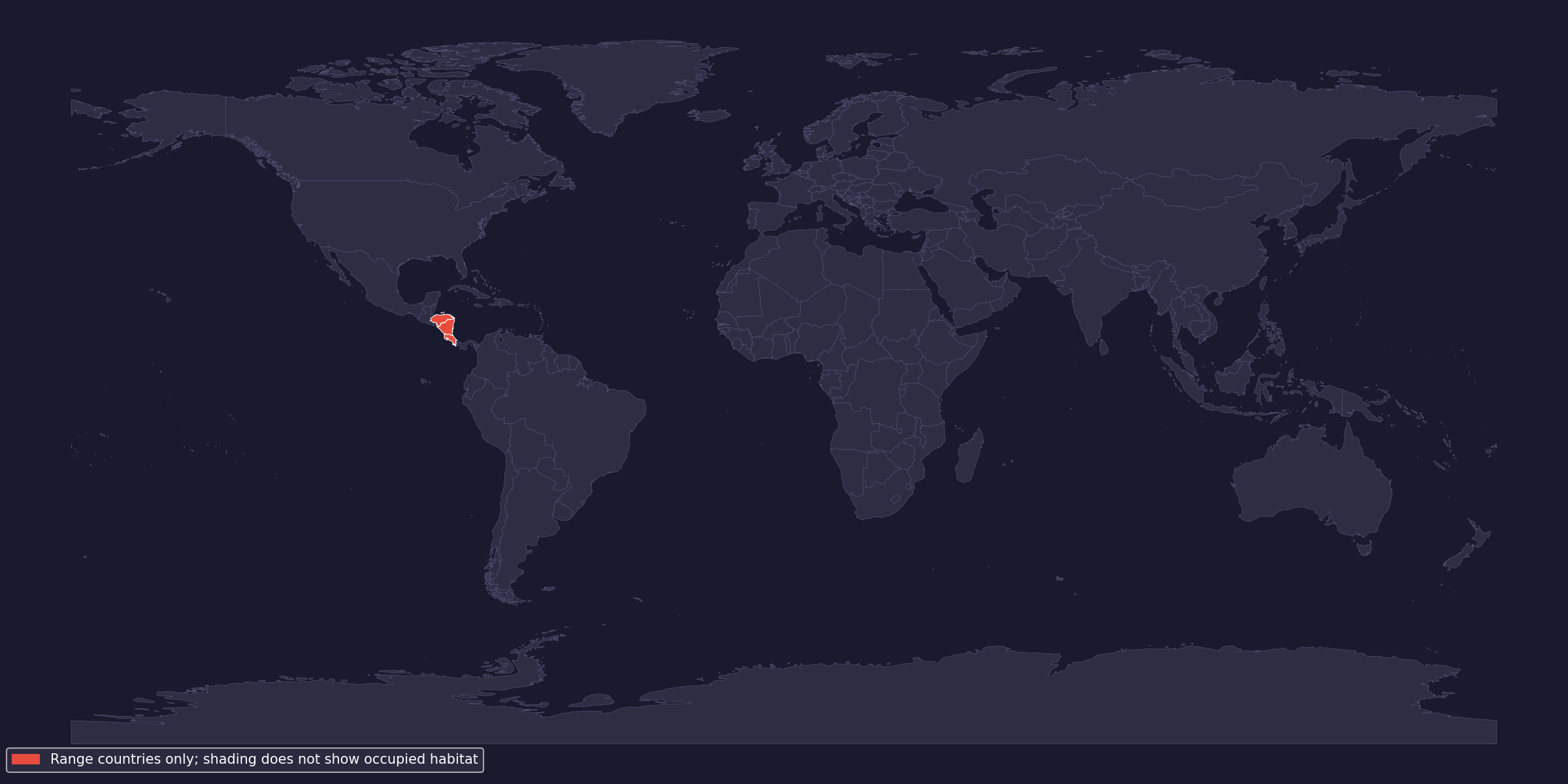
🌡 Climate across the native range
Monthly outdoor normals for 1991–2020 illustrate seasonal and regional differences, not enclosure settings. These approximate landscape coordinates are not exact snake records.
Santa Rosa dry forest — Costa Rica
| Month | Min °C | Mean °C | Max °C | RH % |
|---|---|---|---|---|
| January | 21.6 | 24.2 | 27.8 | 74 |
| February | 21.7 | 24.8 | 29.1 | 70 |
| March | 22.1 | 25.8 | 30.5 | 66 |
| April | 23 | 26.7 | 31.5 | 67 |
| May | 23.2 | 25.8 | 29.6 | 78 |
| June | 22.8 | 24.8 | 28 | 86 |
| July | 22.7 | 24.8 | 27.9 | 83 |
| August | 22.6 | 24.8 | 28.2 | 84 |
| September | 22.3 | 24.3 | 27.5 | 87 |
| October | 22.1 | 23.9 | 26.8 | 88 |
| November | 22 | 23.9 | 26.8 | 84 |
| December | 21.8 | 24 | 27.1 | 79 |
Choluteca lowlands — Honduras
| Month | Min °C | Mean °C | Max °C | RH % |
|---|---|---|---|---|
| January | 23.2 | 28.5 | 34.8 | 51 |
| February | 23.6 | 29.2 | 35.9 | 50 |
| March | 24.3 | 29.9 | 36.7 | 51 |
| April | 25.2 | 30.1 | 36.5 | 60 |
| May | 24.7 | 28.3 | 33.4 | 74 |
| June | 24 | 27.4 | 32.1 | 78 |
| July | 24.3 | 28.6 | 33.8 | 68 |
| August | 24.2 | 28.1 | 33.4 | 73 |
| September | 23.4 | 26.6 | 31.3 | 83 |
| October | 23.1 | 26.3 | 30.8 | 82 |
| November | 22.9 | 27.2 | 32.3 | 69 |
| December | 23.1 | 28.1 | 34 | 56 |
Weather data by Open-Meteo.com · CC BY 4.0 · Monthly normals calculated by Herpeton Academy from daily archive values.
⚖️ Legal status
No CITES or specific EU wildlife-trade annex listing was found. Verify lawful source-country collection, captive breeding and export documentation in Honduras, Nicaragua or Costa Rica. A seller’s former bilineatus label is not proof of legal parent stock or current import permission.
The Bern Convention is not a relevant native-range protection framework for this American species; this does not remove national wildlife or dangerous-animal restrictions.
Legal review: 17 September 2026. National capture, possession, registration, breeding, sale and transport rules may be stricter. Verify permits before transfer and keep invoices, breeder identity, parentage and import records. Trade status does not itself authorize keeping a venomous snake.
🤌 Husbandry
Keep Agkistrodon howardgloydi individually in a locked enclosure within an access-controlled venomous-reptile room. Secondary containment and a lockable shift compartment should permit water changes and cleaning only after the animal has been isolated and visually accounted for. Free-handling is unacceptable. Prepare written bite and escape plans, trained backup cover and a veterinary arrangement before acquisition.
Quarantine for at least 90 days as a working minimum, longer when the veterinarian advises. Use separate tools and a simple enclosure; record feeding, sheds, faeces and body condition. Arrange parasite screening for uncertain-origin animals or abnormal stools. Weigh only through an established protected-contact procedure.
💡 Lighting
Provide about 12-14 hours of visible light during the active season, with darkness at night and shaded retreats. A species-specific UVB requirement has not been demonstrated. If low-level UVB is used, measure exposure and retain complete shade; do not infer lamp strength from habitat photographs. Guard lamps and wiring against contact.
🌡 Heating and temperature
Begin with air at 25-28°C, a local basking surface at 30-32°C, a cool retreat at 23-25°C and night air at 21-24°C. These are cautious working bands, not tolerance limits. Measure air, surface and cool-hide temperatures separately. Thermostat-control heating; check the room during summer because a thermostat cannot cool hot air.
Seasonal cooling requires a documented, locality-specific plan for healthy, established adults. Do not cool new arrivals, thin, sick or gravid animals, or copy an adult breeding cycle onto juveniles. Outdoor monthly normals are not brumation instructions.
Pacific tropical dry-forest seasonality is principally a change in rain and moisture availability, not permission for deep temperate hibernation. Maintain fresh water and a moist retreat during any drier phase; do not cool this species using a copperhead winter schedule.
💧 Humidity and water
Use 55-75% relative humidity as an initial management band, with ventilation and a mostly dry resting surface. Provide a small locally moist retreat during shedding without wetting the whole enclosure. Offer clean drinking water continuously in a stable, shallow bowl, serviced through the protected system. Dry habitat does not mean absence of water. Persistent condensation or repeated retained sheds needs review; never peel skin or force soaking.
🌿 Enclosure and decoration
Use at least the practical 120 × 60 × 60 cm layout in the table and allow the snake to stretch fully. Check door gaps, vents and cable holes against the smallest animal housed. Fix rocks directly to the enclosure base so excavation cannot undermine them; retain clear sightlines to shift doors. Avoid sharp gravel, aromatic wood and unstable piles. Remove waste after securing the snake.
Arrange about 5-8 cm of compactable soil and washed sand with leaf litter, low bark shelters and one locally moist retreat. Keep most resting surfaces dry while buffering moisture beneath cover. The Guanacaste forest-floor setting needs refuge choices, not daily saturation. Paper simplifies quarantine and tracking juvenile prey acceptance.
🐁 Feeding
A primary Costa Rican study found juveniles taking mainly frogs and lizards while adults took rodents. Therefore require evidence that the actual animal feeds independently on a sustainable captive diet. Established adults can take thawed whole mice matched to body width; juveniles may need smaller meals about every 7-10 days under specialist supervision. Do not collect wild amphibians or force-feed at home.
The table gives an initial adult feeding interval of 14-21 days; adjust portions and timing to weight trend and condition. Deliver food through the collection’s protected feeding system. Avoid live rodents and substrate-coated food; dehydration, low temperatures and oversized meals increase regurgitation and impaction concerns. Whole prey normally needs no routine calcium or vitamin dusting. Do not improvise supplementation or force-feeding.
🥚 Breeding
Live-bearing; no egg incubation values apply. Professional sexing and a healthy mature body condition are prerequisites. Species-specific maturity thresholds and a broadly verified captive timetable were not established in the reviewed sources. Maintain individual housing and prepare separate neonatal enclosures before any breeding introduction.
Breeding adds exposure risk. Prepare separate, escape-proof neonatal housing before pairing, avoid permanent cohabitation, and retain parentage, dates, meals and transfer records. Only breed when lawful placements and competent staff are available.
🩺 Common problems
- Overheating: repeated escape attempts or unusual exposed resting require immediate measurement of the cool retreat.
- Dysecdysis and dehydration: review drinking access and the moist refuge; repeated problems need veterinary assessment.
- Respiratory infection or stomatitis: wheezing, bubbles or oral discharge require prompt professional care.
- Dermatitis, impaction, obesity and parasites: dirty wet bedding, substrate ingestion, excessive feeding or persistent weight loss need correction and diagnosis. Do not use automatic deworming or home restraint.
📌 Conclusion
For Gloyd’s cantil, verified independent feeding is the acquisition test, especially for juveniles. A tropical dry season must not become water deprivation, and old subspecies paperwork needs checking against the actual line.
📚 Sources and further reading
ReptiFiles was checked first on 17 September 2026; no species-specific guide was found. Numerical recommendations are separated from directly reported breeding outcomes. Historical care reports are not current medical instructions.
- Reptile Database
- GBIF
- Agkistrodon venom variation (2024)
- Agkistrodon venom and immunochemistry
- Agkistrodon venomics
- Solórzano et al. (1999): diet and venom
- Instituto Clodomiro Picado: medical information
- ReptiFiles
- WHO: snakebite first aid
- CITES Appendices — 5 March 2026
- EU Regulation 2026/1383
- DAERA: venomous-snake keeping guidance
- Baines et al. (2016): UV-Tool