Share

Emerald Tree Skink
🔤 Taxonomy
Lamprolepis smaragdina belongs to Scincidae. Named subspecies and geographically distinct populations occur across its island range; record the breeder’s locality information instead of identifying a subspecies from green colour alone.
📌 Description
This active, long-tailed skink is usually green, sometimes brown or partly brown. Total adult length is about 21.5–25 cm. Budget for around 7–10 years, with longevity varying between animals. Apparent curiosity does not make restraint safe: a startled skink can escape or shed its tail.
| Parameter | Practical reference |
|---|---|
| Adult size | 21.5–25 cm |
| Lifespan (years) | 7–10 |
| Enclosure (L × W × H) | 90 × 45 × 90 cm |
| Basking surface | 33–35 °C |
| Cool zone | 24–29 °C |
| Night | 20–25 °C |
| Humidity | 60–80% |
🌍 Distribution
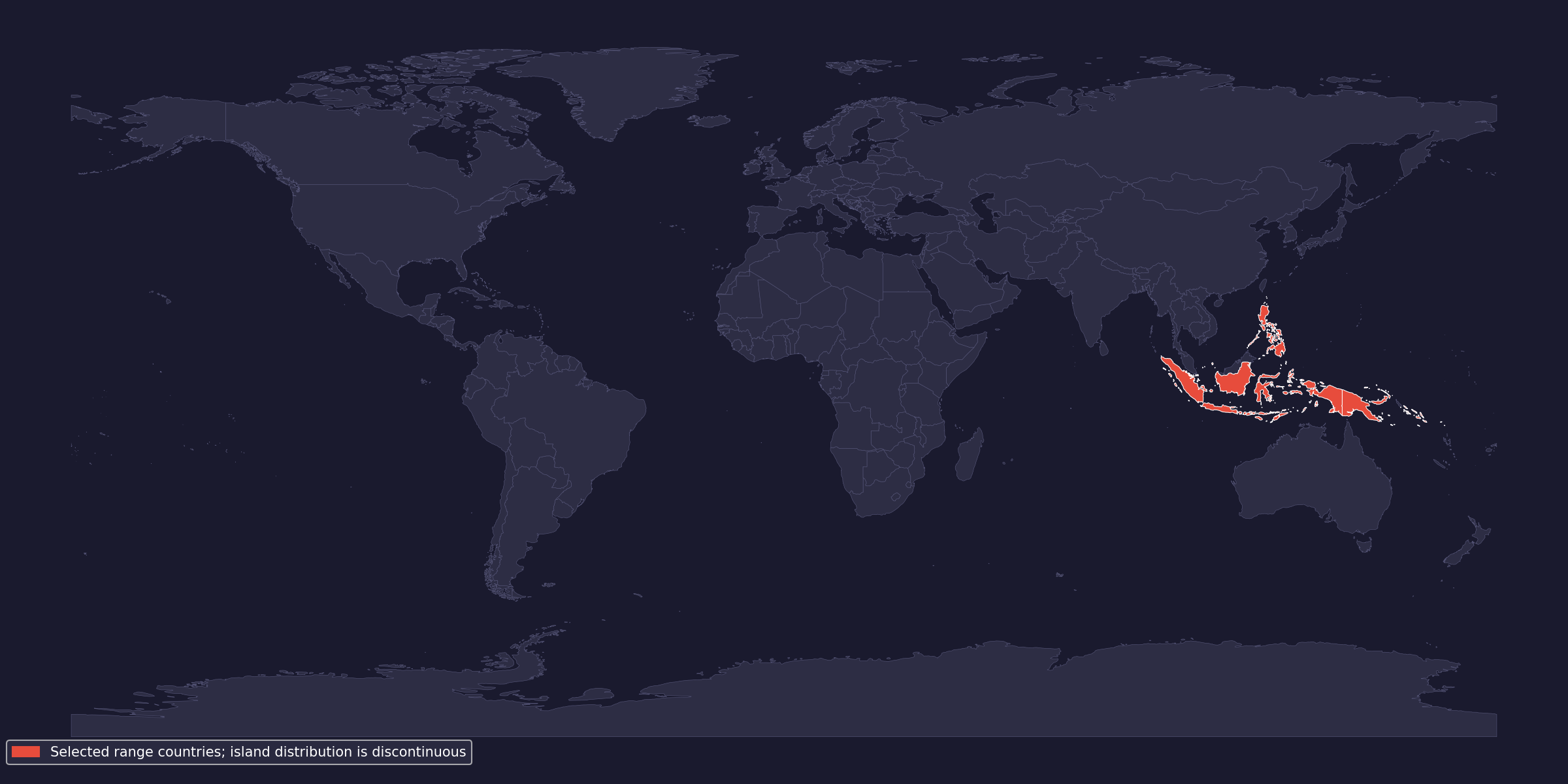
The species occurs on tropical islands from the Philippines and parts of Indonesia to New Guinea and parts of the western Pacific. It uses trunks, branches and forest edges. The map highlights selected countries in a much more fragmented island range; it does not imply continuous occupancy.
🌡 Climate across the native range
Regional outdoor climate at a representative locality. These air-temperature averages are habitat context, not enclosure settings or temperatures inside shelters.
Cebu, Philippines — lowland climate
| Month | Min °C | Mean °C | Max °C | RH % |
|---|---|---|---|---|
| January | 24.7 | 25.7 | 27 | 83 |
| February | 24.6 | 25.8 | 27.1 | 82 |
| March | 25 | 26.3 | 27.9 | 81 |
| April | 25.8 | 27.2 | 28.9 | 81 |
| May | 26.1 | 27.7 | 29.5 | 82 |
| June | 25.9 | 27.4 | 29.3 | 83 |
| July | 25.7 | 27.1 | 29 | 83 |
| August | 25.8 | 27.3 | 29.2 | 82 |
| September | 25.7 | 27.1 | 29.1 | 82 |
| October | 25.5 | 26.8 | 28.6 | 84 |
| November | 25.5 | 26.7 | 28.1 | 84 |
| December | 25.2 | 26.2 | 27.5 | 84 |
Weather data by Open-Meteo.com · CC BY 4.0 · Monthly normals calculated by Herpeton Academy from daily archive values.
⚖️ Legal status
Checked on 2026-09-17: no listing was found for this species or its encompassing taxa in the CITES Appendices or the EU wildlife-trade annexes. The Bern Convention is not relevant to its native range. National rules can still restrict keeping, import, transport or sale. Retain identification and origin records, check destination rules before any transfer, and never release animals or eggs.
🤌 Husbandry
Provide one adult with at least the practical space offered by a 90 × 45 × 90 cm enclosure. Height must contain usable branches, not empty air. Solitary keeping is the simplest starting arrangement; groups require more space, duplicate resources and separation at the first persistent chasing or feeding exclusion. Quarantine new arrivals with dedicated equipment. Use a simple, easily inspected quarantine setup for about 90 days, adjusted with veterinary advice; record food intake, weight and faeces, and arrange faecal testing when indicated.
💡 Lighting
Provide bright visible light and 11–13 hours of daylight. Position UVB and heat over the same branch, aiming for UVI 2–3 at the basking animal’s back and near-zero exposure inside foliage. Measure through the actual mesh at the closest reachable point, and prevent climbing onto lamps.
🌡 Heating and temperature
Provide a 33–35 °C basking surface, cooler air around 24–29 °C and nights around 20–25 °C. Use a dimming thermostat and verify air and surface temperatures independently. Keep a shaded escape route available even near the upper branches; a tall enclosure can trap dangerous heat at the roof.
💧 Humidity and water
Maintain approximately 60–80% daytime humidity, with a brief rise after evening misting and subsequent drying of leaf surfaces. Supply fresh water in a stable accessible bowl; misting droplets are an additional drinking opportunity. Cross ventilation and drainage prevent a humid habitat becoming stagnant and waterlogged.
🌿 Enclosure and decoration
Fit anchored vertical and diagonal branches, cork tubes and dense pesticide-free foliage at several heights. Use 8–10 cm of moisture-retaining soil above a drained base, covered by leaf litter. Keep feeding positions reachable for cleaning. Shield door gaps and cable ports against a fast, slim animal.
🪳 Feeding
Feed gut-loaded insects such as crickets, roaches and locusts as the main diet, with a small amount of suitable complete fruit-based gecko diet about weekly for variety. Feed juveniles daily and adults every other day, adjusting quantity to condition. Dust insects with calcium and use a reptile multivitamin according to UVB provision and its label. Sweet fruit is occasional; fruit alone, dog food and wild-caught insects are unsuitable staples. Choose prey no wider than the space between the eyes; offer smaller items if swallowing looks difficult. With effective measured UVB, use plain calcium for routine dusting and obtain D3 from a coordinated, label-directed vitamin plan; without effective UVB, dietary D3 needs deliberate provision. Do not stack D3 products.
🥚 Breeding
Breeding is optional and requires securely identified compatible animals. Provide a moist, sheltered laying site and separate accommodation for hatchlings; adults may eat small young. Keep locality lines distinct and retain parentage records. Do not increase food and heat indefinitely to promote repeated clutches.
🩺 Common problems
A thin tail base, persistent hiding, swollen jaw, weak grip or wounds need assessment. Check whether another skink monopolizes heat or food before assuming disease, and consult a reptile veterinarian for persistent signs. Capture with a container when necessary; never pull the tail. Weak jaws and poor grip can indicate metabolic bone disease; repeated straining or abdominal swelling may indicate obstruction or egg binding. These require veterinary diagnosis, not extra supplements or home extraction.
📌 Conclusion
This species rewards an enclosure with usable vertical cover, bright light and access to shade. For a different arboreal design, see the crested gecko guide; its cooler thermal requirements are not interchangeable.
📚 Sources and further reading
- ReptiFiles — emerald tree skink care
- The Reptile Database — Lamprolepis smaragdina
- Ecology Asia — field natural history
- Baines et al. (2016) — UV-Tool
- GBIF — Lamprolepis smaragdina
- CITES — official appendices, government publication (2026)
- EU — Regulation 338/97, consolidated 2026-06-29
- Bern Convention — appendices