Share

Caribbean Hermit Crab
🔤 Taxonomy
Coenobita clypeatus is the Caribbean land hermit crab, commonly called the purple pincher. It is not interchangeable with marine aquarium hermit crabs or every other Coenobita. The purple major claw helps recognition, but reliable identification considers the whole animal.
📌 Description
An adult’s body can reach approximately 3–6 cm, excluding its borrowed shell and extended legs. This is a long-term commitment: 10–20 years or more is possible with suitable care. It needs companions, deep molting substrate and humid air, not a small dry souvenir cage.
| Parameter | Practical reference |
|---|---|
| Adult size | 3–6 cm |
| Lifespan (years) | 10–20 |
| Enclosure (L × W × H) | 90 × 45 × 45 cm |
| Daytime air | 25–28 °C |
| Night | 24–26 °C |
| Humidity | 75–85% |
🌍 Distribution
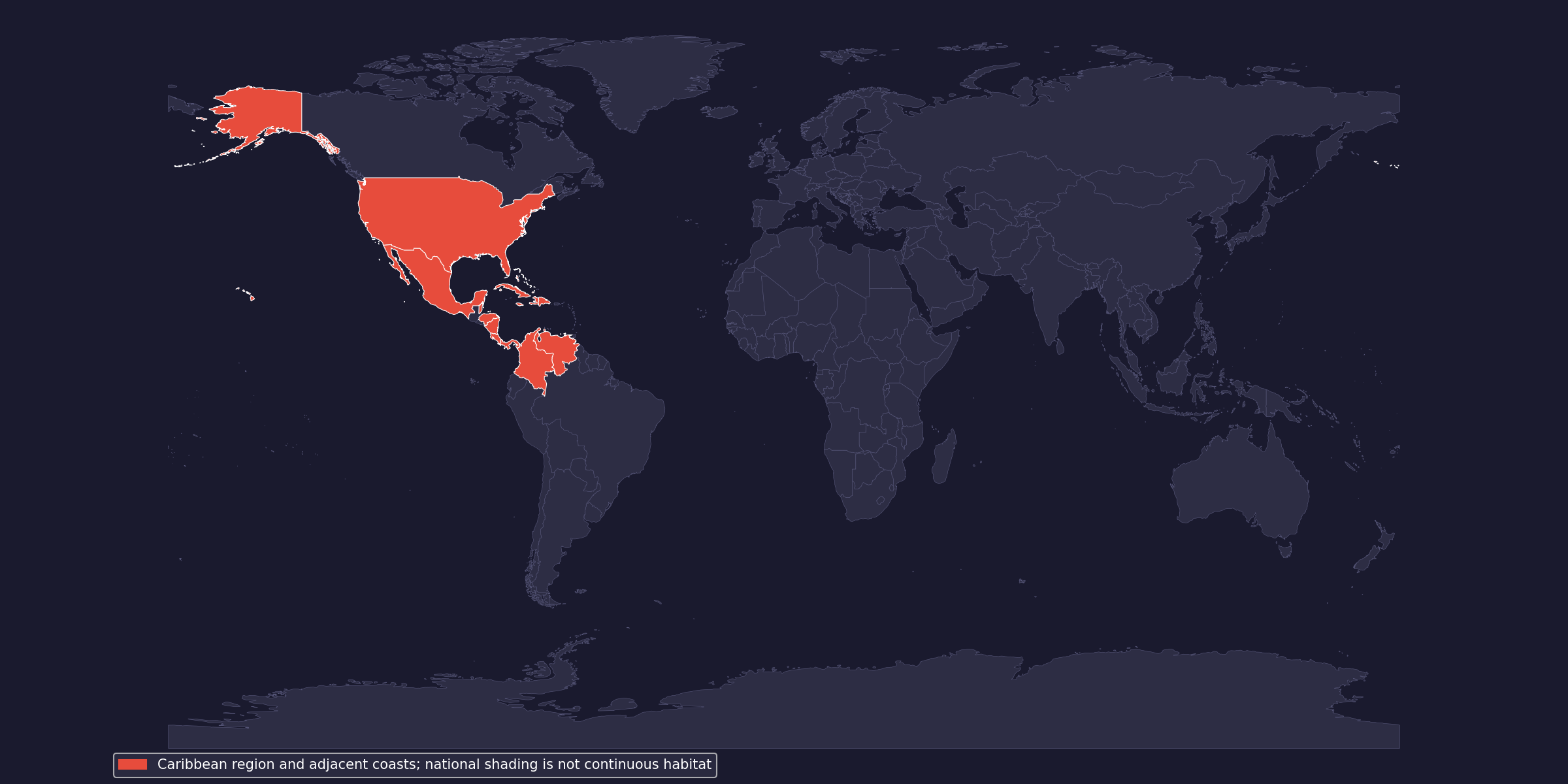
The species occupies coastal and inland habitats around the Caribbean, including islands and mainland shores. Reproduction still depends on the sea because larvae develop in seawater. The map is a broad outline of range countries, not a claim that every inland part is inhabited.
⚖️ Legal status
Checked on 2026-09-17: no listing was found for this species or its encompassing taxa in the CITES Appendices or the EU wildlife-trade annexes. The Bern Convention is not relevant to its native range. National rules can still restrict keeping, import, transport or sale. Retain identification and origin records, check destination rules before any transfer, and never release animals or eggs.
🤌 Husbandry
For a small group start with a securely covered 90 × 45 × 45 cm tank; larger crabs and groups need more floor area. Prepare spare natural shells before arrival. New animals need separate observation with suitable humidity, pools and molting substrate, not a dry quarantine box. Never pull a crab out of its shell or excavate a buried crab merely to check it.
💡 Lighting
Provide a 12-hour light cycle with shaded hiding places and darkness at night. UVB is not an established minimum requirement. Do not use coloured night lamps or direct sun through glass; warming must not destroy the humid environment.
🌡 Heating and temperature
Maintain air around 25–28°C, with nights approximately 24–26°C. Measure above the substrate where the crabs move. If needed, mount thermostatically controlled heat on the outside back above substrate level, never beneath the molting bed. Monitor more than one point and keep pools away from electrical fittings.
💧 Humidity and water
Maintain about 75–85% humidity. Provide separate dechlorinated freshwater and marine-saltwater pools, each deep enough to submerge the shell, with secure ramps usable by the smallest crab. Prepare salt water with marine aquarium salt according to its seawater directions, not table salt. Change unfiltered pool water frequently and remove waste immediately. Sponges do not replace pools.
🌿 Enclosure and decoration
Use at least 15 cm of sand-rich substrate, or three times the height of the largest crab, whichever is greater. A roughly 5:1 mix of washed play sand and coir should hold a tunnel without dripping. Do not routinely turn or replace occupied molting substrate. Support heavy pools on the base. Supply several unpainted, appropriately sized shells per crab, leaf litter, climbing wood and private hides.
🪳 Feeding
Offer varied small meals daily: unseasoned animal protein, vegetables, some fruit, leaves and suitable seeds. Keep a clean calcium source such as cuttlebone available. Remove perishable leftovers before they spoil. A single pellet, sweet fruit or coconut alone is not a complete diet. Avoid salt-seasoned human food and pesticide-treated plant material; never use aquarium medications without confirming crustacean safety.
🥚 Breeding
Females carry eggs, then release larvae into seawater. Raising them requires a dedicated marine larval system and later transition to land; an ordinary two-pool terrarium cannot complete that process reliably. Do not describe a seller’s wild-collected juvenile as captive-bred without evidence. Breeding is an expert project, not an automatic outcome of keeping a pair.
🩺 Common problems
Burial can last weeks or longer during molting; do not dig an animal up. Sudden shell abandonment, repeated aggression, foul flooded substrate or surface molting demands careful assessment of humidity, shells, diet and disturbance. Protect a vulnerable surface molter from tankmates without touching its soft body. Seek an exotics veterinarian experienced with crustaceans for injury or ongoing decline. A shed skin alone does not mean the crab has died.
📌 Conclusion
Adopt or obtain responsibly sourced animals only after the complete humid habitat is stable. Safe molts, spare shells and both pools remain essential throughout this animal’s potentially decades-long life.
📚 Sources and further reading
- LHCOS — essential land hermit crab care
- Hermit Crab Association — species care
- Hermit Crab Association — habitat and substrate
- Naturalis — Coenobita ecology
- GBIF — Coenobita clypeatus
- CITES — official appendices, government publication (2026)
- EU — Regulation 338/97, consolidated 2026-06-29
- Bern Convention — appendices