Share

Blue Death-feigning Beetle
🔤 Taxonomy
Asbolus verrucosus is a darkling beetle in Tenebrionidae. Its pale blue appearance comes from a surface wax, not blue pigment throughout the shell. Other death-feigning beetles are separate species and should not automatically receive identical care.
📌 Description
Adults are approximately 1.5–2.5 cm long and may live 5–8 years or longer. Many offered animals are wild-collected adults of unknown age. When disturbed they can become rigid and remain motionless; do not repeatedly provoke this response or mistake it alone for death.
| Parameter | Practical reference |
|---|---|
| Adult size | 1.5–2.5 cm |
| Lifespan (years) | 5–8 |
| Enclosure (L × W × H) | 60 × 30 × 30 cm |
| Daytime air | 23–27 °C |
| Basking surface | 28–30 °C |
| Cool zone | 21–24 °C |
| Night | 18–22 °C |
| Humidity | 20–40% |
🌍 Distribution
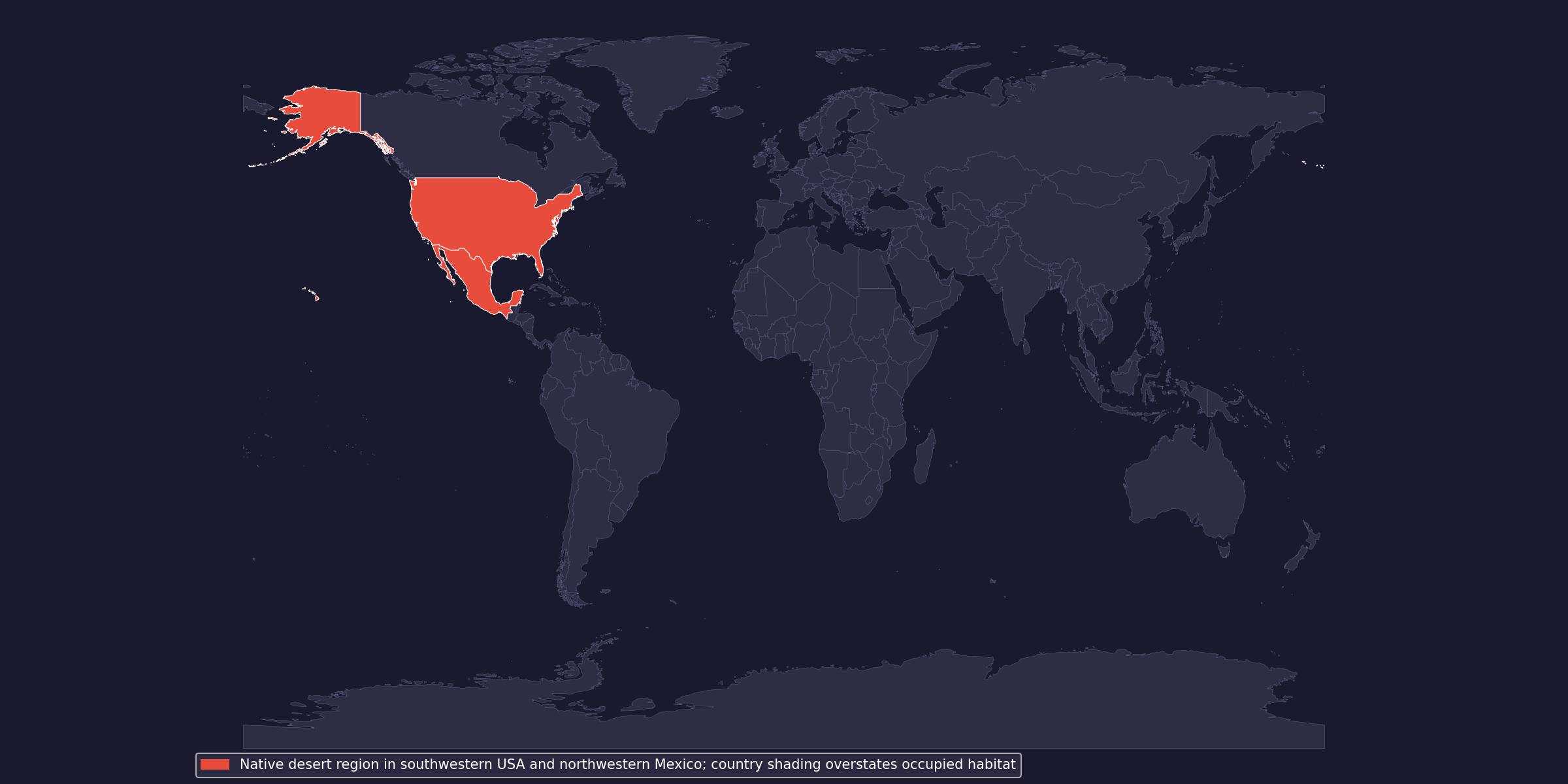
Native habitat lies in the dry southwestern United States and northwestern Mexico. Country shading substantially overstates the occupied desert region. Adults use shade and surface shelters as well as exposed ground; desert origin does not justify heating the whole enclosure intensely.
⚖️ Legal status
Checked on 2026-09-17: no listing was found for this species or its encompassing taxa in the CITES Appendices or the EU wildlife-trade annexes. The Bern Convention is not relevant to its native range. National rules can still restrict keeping, import, transport or sale. Retain identification and origin records, check destination rules before any transfer, and never release animals or eggs.
🤌 Husbandry
A 60 × 30 × 30 cm ventilated enclosure provides a practical starting point for a small group. Check each animal can reach food and shelter. Keep new arrivals separately for several weeks on a simple substrate, using separate tools and recording activity and feeding. Avoid mixing with scorpions, large spiders or vertebrates.
💡 Lighting
Use a 12-hour day with diffuse light and shaded shelters. UVB has not been established as necessary. Place lamps outside the enclosure and prevent access to hot fittings. Darkness at night allows normal changes in activity.
🌡 Heating and temperature
Provide air around 23–27°C, a small warm surface around 28–30°C and a cooler refuge around 21–24°C. Allow 18–22°C at night. A low-output overhead lamp under thermostat control can create the gradient; check surfaces with an infrared thermometer and air with a probe. Do not convert published larval-rearing temperatures into adult housing targets.
💧 Humidity and water
Keep adult housing dry and ventilated, approximately 20–40% relative humidity where practical. Offer moisture in fresh vegetables and an extremely shallow water cap with an easy exit. Do not mist the beetles: wetting temporarily darkens their wax coating and persistent damp promotes mold. Do not wash an animal to restore its colour.
🌿 Enclosure and decoration
Use roughly 5–8 cm of firm, diggable, pesticide-free soil and sand, with a dry upper layer. Pure loose sand gives poor footing; avoid calcium sand and dusty powders. Support stones on the enclosure base so digging cannot undermine them. Provide low cork shelters and inspect hollow decorations for openings in which a beetle could become trapped.
🪳 Feeding
Offer small portions daily or every other day: dead feeder insects or suitable fish food for protein, alongside carrot, squash or leafy vegetables. Remove moist remains within a day. This is a scavenging omnivore, not an animal to maintain on sweet fruit alone. Avoid salted foods, pesticide residues and live biting prey. Routine reptile vitamin dusting is unnecessary.
🥚 Breeding
Egg laying does not guarantee successful breeding. Larvae require a separate, researched moisture and pupation regime; repeatedly wetting the adult terrarium is not a substitute. Zoo work documents the difficulty of completing development. An uncertain egg duration is deliberately not presented as a guaranteed incubation timetable. Plan larval space before retaining eggs.
🩺 Common problems
Temporary darkening after water contact differs from ongoing lethargy or inability to walk. Check temperature, trapped legs, recent chemical exposure and spoiled food. Never apply insecticides or mite treatments without specialist veterinary advice. A damaged shell, leaking body fluid or persistent inability to right itself warrants an invertebrate-experienced veterinarian; do not test health by repeatedly dropping or poking the animal.
📌 Conclusion
This species suits a dry display enclosure with regular food hygiene. Adult maintenance is much simpler than breeding, and a seller’s claim of captive breeding should be supported by records.
📚 Sources and further reading
- Chicago Exotics Animal Hospital — adult beetle care
- Maloney — breeding research at Topeka Zoo (2024)
- Cincinnati Zoo — Blue death-feigning beetle
- GBIF — Asbolus verrucosus
- CITES — official appendices, government publication (2026)
- EU — Regulation 338/97, consolidated 2026-06-29
- Bern Convention — appendices