Share

Barking Gecko
🔤 Taxonomy
Underwoodisaurus milii is a carphodactylid gecko, also called the thick-tailed gecko. Older sources may use Nephrurus milii. It is distinct from Underwoodisaurus seorsus and from the border thick-tailed gecko, now Uvidicolus sphyrurus.
📌 Description
Pale spots cover a brown body and broad tail; a disturbed animal can produce a short bark. Adults reach about 12–16.5 cm overall. Plan for a possible 15–20-year commitment, rather than assuming the age of an adult purchase is known. Avoid grabbing the tail or provoking defensive calls.
| Parameter | Practical reference |
|---|---|
| Adult size | 12–16.5 cm |
| Lifespan (years) | 15–20 |
| Enclosure (L × W × H) | 60 × 45 × 45 cm |
| Basking surface | 28–30 °C |
| Cool zone | 22–25 °C |
| Night | 18–22 °C |
| Humidity | 40–50% |
🌍 Distribution
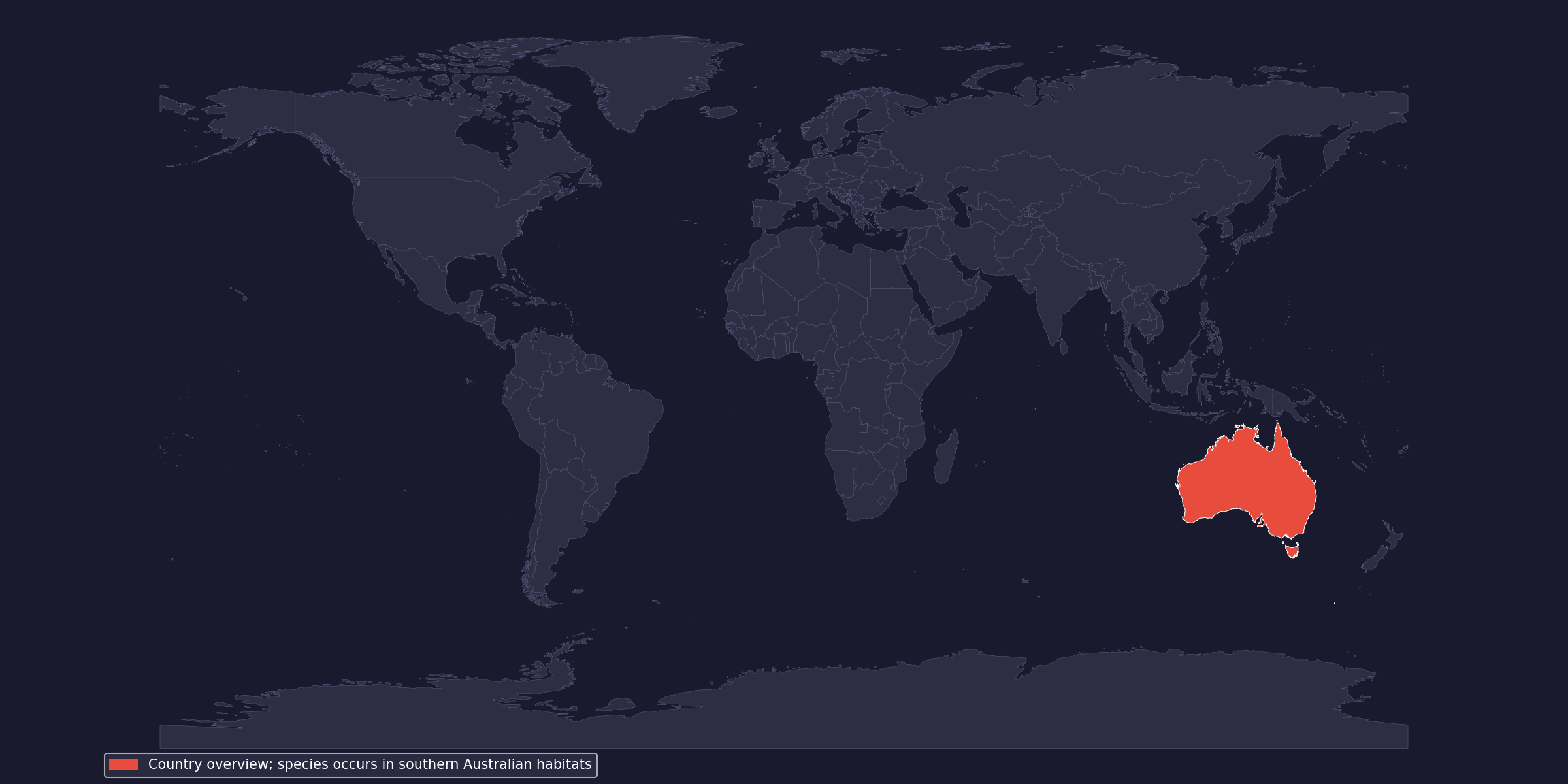
This Australian species occupies varied southern habitats, including rocky woodland and shrubland. Cool crevices shelter it from exposed summer heat. A country-scale map cannot show this patchy range, and regional weather must not be copied directly into its enclosure.
🌡 Climate across the native range
Regional outdoor climate at a representative locality. These air-temperature averages are habitat context, not enclosure settings or temperatures inside shelters.
Shark Bay, Western Australia
| Month | Min °C | Mean °C | Max °C | RH % |
|---|---|---|---|---|
| January | 22.9 | 26.3 | 31.6 | 62 |
| February | 24 | 27.2 | 32.3 | 63 |
| March | 23.3 | 26.6 | 31.4 | 61 |
| April | 21.3 | 24.4 | 28.7 | 62 |
| May | 18.4 | 21.5 | 25.2 | 61 |
| June | 15.9 | 18.9 | 22 | 64 |
| July | 14.7 | 17.9 | 21 | 65 |
| August | 15 | 18.3 | 22 | 62 |
| September | 16.2 | 19.4 | 23.6 | 60 |
| October | 17.9 | 21.1 | 25.9 | 60 |
| November | 19.6 | 22.9 | 27.7 | 60 |
| December | 21.4 | 24.8 | 29.9 | 61 |
Weather data by Open-Meteo.com · CC BY 4.0 · Monthly normals calculated by Herpeton Academy from daily archive values.
⚖️ Legal status
Checked on 2026-09-17: Underwoodisaurus spp. is listed in CITES Appendix III at Australia’s request and EU Annex C. International movements may require an export permit, certificate of origin or re-export certificate, depending on the route and origin. Obtain advice from the relevant CITES authority before shipping and keep dated acquisition and breeding records. Bern is not relevant to the native range; national keeping rules still apply.
🤌 Husbandry
A ventilated 60 × 45 × 45 cm enclosure is a useful starting point for one adult. Solitary housing avoids breeding pressure and competition; never combine adult males. Quarantine acquisitions and use individual feeding and weight records before considering any pairing. Use a simple, easily inspected quarantine setup for about 90 days, adjusted with veterinary advice; record food intake, weight and faeces, and arrange faecal testing when indicated.
💡 Lighting
Provide a regular 12-hour light cycle and complete darkness at night. Offer low-intensity UVB over part of the enclosure, with fully shaded retreats. Measure exposure at the animal’s level and follow the lamp’s distance guidance; nocturnal activity does not mean the animal must be deprived of optional daytime exposure.
🌡 Heating and temperature
Provide a modest warm surface at 28–30 °C and cool retreats around 22–25 °C; an ordinary night drop to 18–22 °C is suitable. Use thermostatic control and separate air and surface measurements. Do not heat the whole enclosure to 30 °C. A seasonal breeding rest requires a separate, health-assessed plan; do not use refrigerator methods described for other species.
💧 Humidity and water
Aim for roughly 40–50% general humidity with a permanently available moist hide and fresh water in a shallow bowl. Lightly wet one area as needed while letting exposed surfaces dry. Good airflow and access to a humid retreat matter more than forcing a single humidity reading all day.
🌿 Enclosure and decoration
Use about 5–8 cm of compactable soil and sand, low anchored branches, cork and secure rock crevices. Put heavy rocks on the base, never on excavatable substrate. Include dry and damp shelters at suitable temperatures and enough cover to move between them unseen. During quarantine, use easily replaced paper and a separate moist hide. Feed from a clean dish where practical: swallowed substrate, dehydration and insufficient heat can contribute to impaction.
🪳 Feeding
Offer varied gut-loaded crickets, roaches and other suitably sized insects. Feed adults every 2–3 days, young animals more frequently, and adjust portions to condition. Dust with calcium and use a reptile multivitamin matched to UVB and label instructions; do not put vitamins routinely in drinking water. Fatty larvae should remain occasional treats. Remove biting prey before leaving the animal overnight. Choose prey no wider than the space between the eyes; offer smaller items if swallowing looks difficult. With effective measured UVB, use plain calcium for routine dusting and obtain D3 from a coordinated, label-directed vitamin plan; without effective UVB, dietary D3 needs deliberate provision. Do not stack D3 products.
🥚 Breeding
Females usually lay pairs of eggs in a moist laying site. One published breeder reported 73–82 days at an average 26.5 °C; 26–27 °C is a reference range, not a guaranteed hatch date. Keep eggs off wet surfaces, monitor an independent thermometer and prepare separate hatchling accommodation. Protect females from continuous reproduction.
💤 Seasonal rest
Only consider planned seasonal cooling for healthy, established adults after veterinary advice. Do not cool juveniles, new arrivals, thin or ill animals. Check weight, hydration, parasite status and equipment first; monitor weight, behaviour and temperatures throughout and stop for veterinary review if condition declines.
🩺 Common problems
Weight loss, retained toe shed, swollen joints and persistent refusal of food need prompt husbandry review and a reptile veterinarian. Barking or tail waving signals disturbance; withdraw and let the animal settle. Never pull stuck shed or force a defensive gecko to eat. Weak jaws and poor grip can indicate metabolic bone disease; repeated straining or abdominal swelling may indicate obstruction or egg binding. These require veterinary diagnosis, not extra supplements or home extraction.
📌 Conclusion
Reliable cool retreats and careful heat control are central to keeping this species. The viper gecko guide offers a useful comparison, but its warmer basking setting should not be transferred automatically.
📚 Sources and further reading
- Laube and Porter — captive maintenance and breeding
- Italian Gekko Association — Underwoodisaurus milii
- Josh’s Frogs — Australian barking gecko
- Swell Reptiles — lifespan and care
- Baines et al. (2016) — UV-Tool
- GBIF — Underwoodisaurus milii
- CITES — official appendices, government publication (2026)
- EU — Regulation 338/97, consolidated 2026-06-29
- Bern Convention — appendices