Share

African Fat-Tailed Gecko
🔤 Taxonomy
Hemitheconyx caudicinctus is the currently accepted scientific name. In the hobby and in trade, the species is usually sold under the same name or under its common-name equivalents.
English common names used in the hobby:
- African fat-tailed gecko
- Fat-tail gecko
German common names used in the hobby:
- Afrikanischer Fettschwanzgecko
📌 Description
The African fat-tailed gecko (Hemitheconyx caudicinctus) is a ground-dwelling eyelid gecko from West Africa. It is often compared with the leopard gecko, but it is not simply a darker, more humid version of the same animal. It tends to be more secretive, slower-moving, and more dependent on secure hides and moisture gradients.
Adults usually reach 20-25 cm. The tail stores fat and should look rounded and segmented, but not swollen. A very thin tail, sudden weight loss, or a tail that continues shrinking despite feeding can indicate stress, parasites, poor temperatures, or another health problem.
With stable care, African fat-tailed geckos often live 15-20 years, and longer lifespans are possible. Settled individuals often tolerate gentle handling, but keep sessions short and let the gecko’s response set the limit. This is a moderate-handling species, not a display-only animal or a pet for prolonged handling.
📋 Quick reference
| Care point | Practical target |
|---|---|
| Adult size and lifespan | 20-25 cm; commonly 15-20 years |
| Adult enclosure | At least 90 × 45 × 45 cm, with more floor space when possible |
| Heat | Warm hide 32-34°C in the warm season; cool side 22-25°C; measured overhead heat |
| Night and cooling | 22-25°C in the warm season; planned cool period only for healthy adults |
| Humidity | About 70-80% daytime in the wetter period, around 50% in the drier period, higher at night |
| UVB | Ferguson Zone 1; about UVI 0.5-1.0 with shaded retreats near zero |
| Substrate | Compact soil-sand-clay style mix, usually 8-10 cm deep or more for adults |
| Diet | Varied, gut-loaded insects; prey no wider than the space between the gecko’s eyes |
| Supplements | Plain calcium at most meals, with D3 and multivitamin adjusted to UVB use |
| Quarantine | Simple paper-towel setup for new arrivals until feeding, shedding, feces, and parasite risk are understood |
🌍 Distribution
The species occurs in West Africa, from Senegal through countries around the Gulf of Guinea and toward northern Cameroon. It lives in dry Sahel, dry and moist savanna, woodland edges, rocky areas, burrows, crevices, and leaf litter.
Important habitat features include:
- Warm days and cooler sheltered retreats
- Seasonal changes between wetter and drier periods
- Burrows, rocks, roots, bark, and leaf litter for cover
- Moderately humid microclimates, even in otherwise dry landscapes
- Night activity and daytime hiding
In captivity, the goal is a warm, secure, well-ventilated enclosure with enough moisture for healthy shedding, not a wet tropical box and not a dry desert setup.
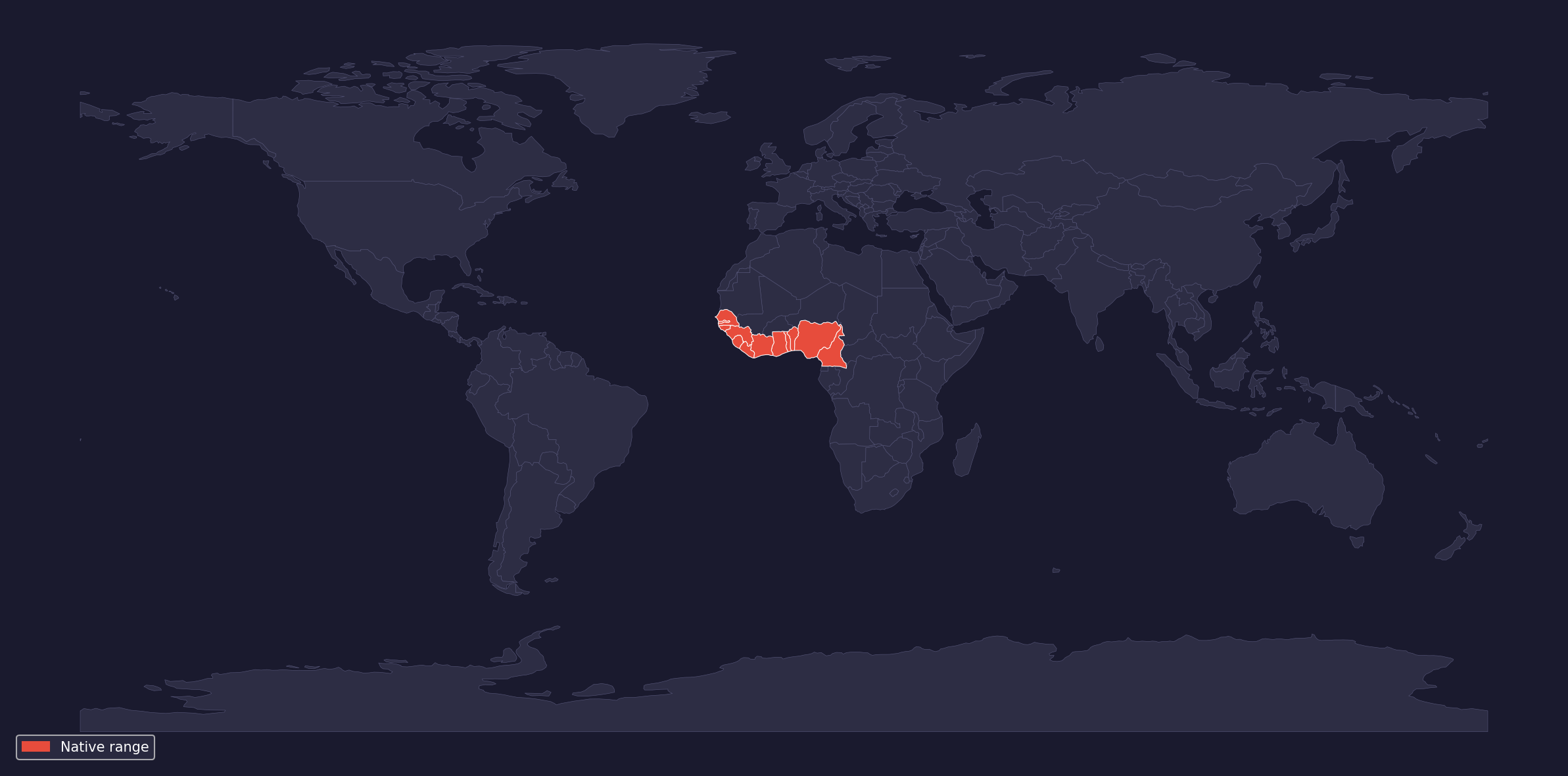
🌡 Climate across the native range
Monthly climate normals from reviewed GBIF occurrence locations:
Mayo-Kebbi Ouest — Chad
| Month | Min °C | Mean °C | Max °C | RH % |
|---|---|---|---|---|
| January | 18.8 | 25.7 | 33.5 | 19 |
| February | 21.2 | 28.5 | 36.5 | 14 |
| March | 24.5 | 31.9 | 39.6 | 14 |
| April | 26.7 | 33.1 | 39.7 | 31 |
| May | 26.1 | 31.1 | 36.7 | 53 |
| June | 24.5 | 28.7 | 33.6 | 67 |
| July | 23 | 26.5 | 30.6 | 76 |
| August | 22.3 | 25.2 | 28.9 | 82 |
| September | 22.4 | 25.9 | 29.9 | 82 |
| October | 22.8 | 27.6 | 33 | 68 |
| November | 21.5 | 27.9 | 35.2 | 32 |
| December | 19.3 | 26 | 33.6 | 23 |
Lower River — Gambia
| Month | Min °C | Mean °C | Max °C | RH % |
|---|---|---|---|---|
| January | 19 | 25.1 | 32.4 | 32 |
| February | 20.1 | 26.6 | 34.5 | 30 |
| March | 21.1 | 28.2 | 36.4 | 34 |
| April | 21.9 | 28.8 | 37.2 | 42 |
| May | 22.9 | 28.8 | 36.7 | 52 |
| June | 24.4 | 28.8 | 35.1 | 65 |
| July | 24.4 | 27.3 | 31.5 | 79 |
| August | 24.1 | 26.4 | 30 | 85 |
| September | 24.1 | 26.7 | 30.5 | 85 |
| October | 24.4 | 27.8 | 32.2 | 80 |
| November | 22.4 | 27.8 | 34 | 55 |
| December | 20 | 25.8 | 32.8 | 38 |
Thiès — Senegal
| Month | Min °C | Mean °C | Max °C | RH % |
|---|---|---|---|---|
| January | 18.2 | 23.8 | 31.1 | 33 |
| February | 18.9 | 24.7 | 32.5 | 35 |
| March | 19.4 | 25.3 | 33.7 | 42 |
| April | 19.6 | 25.4 | 33.7 | 51 |
| May | 20.7 | 25.8 | 33 | 60 |
| June | 22.8 | 26.5 | 31.5 | 72 |
| July | 24.4 | 27.1 | 30.7 | 76 |
| August | 24.7 | 26.9 | 29.8 | 81 |
| September | 24.7 | 27 | 30.1 | 84 |
| October | 24.4 | 27.8 | 32.4 | 75 |
| November | 22.2 | 27.2 | 33.8 | 51 |
| December | 19.6 | 25 | 32 | 39 |
Weather data by Open-Meteo.com · CC BY 4.0 · Monthly normals calculated by Herpeton Academy from daily archive values.
Location references use GBIF.org occurrence data where available; original occurrence records retain their source dataset licenses.
⚖️ Legal status
As checked against current CITES and EU wildlife trade sources in April 2026, Hemitheconyx caudicinctus was not found in the CITES Appendices, and no specific listing was found in the EU Wildlife Trade Annexes used for European import and trade controls.
The species is not native to Europe, so the Bern Convention is not the main legal framework for ordinary captive keeping. However, national and local rules may still apply to import, transport, sale, breeding, animal welfare, and proof of legal origin.
Choose captive-bred animals from transparent breeders or shops. Wild-caught fat-tailed geckos are still seen in trade in some places and are more likely to arrive stressed, dehydrated, parasitized, or poorly adapted to captive food.
🤌 Husbandry
An adult African fat-tailed gecko should have a terrarium with a minimum footprint of about 90 × 45 cm, with 45 cm height being enough for most setups. More floor space is better, especially if it allows deeper substrate, more hides, and a proper temperature gradient.
The enclosure should have:
- A warm side and a cool side
- Several tight hides, including warm, cool, and humid options
- Cork bark, rocks, roots, leaf litter, and low climbing structure
- A shallow water dish
- Good ventilation without drying every hide completely
Solitary housing is the safest default. Males can fight, and mixed pairs can cause stress and repeated breeding. Even animals that appear calm together may compete quietly for hides, food, warmth, or security.
Quarantine new arrivals before moving them into a planted or bioactive display enclosure, especially if other reptiles are already in the home. Keep the animal in a separate simple setup for about 60-90 days, use separate tools, weigh it regularly, record meals, sheds, and droppings, and arrange a fecal parasite check with a reptile veterinarian when origin or stool quality is uncertain.
Allow a new arrival at least 2 weeks to settle and ensure it is eating reliably before optional handling. Offer your hand in the evening and let the gecko approach. Start with sessions of about 5 minutes, supporting its feet, body, and tail close to a low, soft surface. Never grab or restrain it by the tail: it can shed the tail defensively. End the session if it struggles or tries to escape; do not force contact.
💡 Lighting
African fat-tailed geckos are mostly nocturnal, but they still benefit from a clear day-night cycle. Provide about 11-13 hours of light depending on season, or a simple 12-hour cycle if seasonal control is not practical.
Low-output UVB can be beneficial when installed correctly. It should cover only part of the enclosure, overlap the warm side, and leave shaded retreats available. The gecko must be able to choose between light, shade, warmth, and cover.
If UVB is not used, supplementation must provide vitamin D3 carefully. If UVB is used, supplements should be adjusted so vitamin D3 is not overdone.
For UV planning, treat this species as Ferguson Zone 1. Aim for about UVI 0.5-1.0 in the upper exposed area, while leaving retreats and a gradient down to shaded areas near zero UVI. This usually points to a low-output UVB tube such as a ShadeDweller-style or 2-7% T5, chosen for the enclosure height; measure with a Solarmeter 6.5 when possible, because reflector, mesh, distance, and lamp age change the real exposure.
🌡 Heating and temperature
Heat should come mainly from above, using a halogen lamp or deep heat projector controlled by a thermostat or dimming thermostat. A warm hide under the heat source allows the gecko to warm up while still feeling secure.
Useful ranges for most keepers:
- Warm hide: 32-34°C during the warmer season
- Cool side: 22-25°C
- Night: 22-25°C in the warm season, with cooler seasonal nights only if managed deliberately
- Cooler seasonal period: warm hide around 26°C, cool side around 20-23°C, and nights around 17-18°C for healthy adults
Juveniles should be kept in the warmer, more stable range. Measure surface temperatures with an infrared thermometer and air temperatures with digital probes. Avoid heat rocks, because they can burn reptiles.
Do not use the cool-season numbers as automatic brumation for every animal. Cooling should be gradual, reserved for healthy established adults, and stopped if the gecko loses condition, refuses food outside a normal seasonal pattern, or cannot access a safe warm retreat.
💧 Humidity and water
African fat-tailed geckos need more humidity than leopard geckos. A practical captive target is moderate daytime humidity with higher humidity at night, while still allowing the surface to breathe and avoid stagnation.
Seasonal cycling can be useful:
- Warmer, wetter period: around 70-80% daytime humidity, higher at night
- Cooler, drier period: around 50% daytime humidity, rising at night
- Humid hide: available at all times
The humid hide is essential for shedding and hydration. Keep it moist but not sour, flooded, or moldy. Fresh water should always be available in a shallow dish, even if the gecko is rarely seen drinking.
If shed is retained on toes, tail tip, or head, treat it as a husbandry warning first. Improve the humid hide, airflow, and rough shedding surfaces; a brief ventilated shed box with damp paper towel can soften stuck skin, but do not pull dry skin from toes or eyes.
🌿 Enclosure and decoration
The enclosure should feel sheltered from the gecko’s point of view. An open box with one hide is stressful even if the temperatures are correct.
Suitable substrate options include:
- A compact soil-sand-clay mix
- A semi-arid or dry-forest reptile substrate
- Leaf litter over part of the enclosure
- Paper towel for quarantine, new arrivals, or sick animals
For established healthy adults, aim for about 8-10 cm of naturalistic substrate, deeper where the layout allows. A practical mix is roughly 40-50% plain topsoil, 30-40% washed play sand, and 10-20% clay or excavator-clay style material, adjusted so it compacts lightly instead of staying dusty or collapsing. It should hold some moisture below the surface while drying on top.
Pure loose sand, calcium sand, very dusty mixes, wood shavings, and loose particles that stick heavily to prey are poor choices. Juveniles, thin animals, and new imports are safer on paper towel until feeding and droppings are easy to monitor. To reduce impaction risk, offer insects from a dish, tile, or clear feeding area and avoid prey that is too large or coated in substrate.
Decor can include cork bark, hollow logs, stable stones, roots, low branches, ledges, fake plants, drought-tolerant live plants, and leaf litter. Make sure heavy pieces cannot collapse if the gecko digs underneath them.
🪳 Feeding
African fat-tailed geckos are insectivores. Offer variety instead of relying on one feeder insect.
Suitable feeders include:
- Crickets
- Dubia or discoid roach nymphs
- Locusts
- Black soldier fly larvae
- Silkworms
- Hornworms as occasional hydrated feeders
- Mealworms as part of a varied diet
Juveniles usually eat daily or every other day. Young adults often eat every two or three days. Healthy adults commonly do well with feeding every four or five days, adjusted by body condition and season.
Feeders should be no wider than the space between the gecko’s eyes, well gut-loaded for 24-48 hours, and lightly dusted according to the lighting setup. Fatty larvae should be occasional treats, not staples. An obese gecko may have a tail wider than the neck, fat deposits, and reduced activity.
A practical supplement schedule:
| Setup | Most meals | Twice monthly | Occasional / product-dependent |
|---|---|---|---|
| Measured UVB available | Plain calcium without D3 | Reptile multivitamin | Low-D3 calcium only if the product plan calls for it |
| No UVB available | Plain calcium without D3 | Calcium with D3 | Reptile multivitamin every 2-4 weeks |
| Juvenile or breeding female | Plain calcium at most meals | Multivitamin on schedule | D3 adjusted to UVB and body condition |
Use the product label as the upper limit and avoid stacking several D3 or vitamin products at once. Poor heat, poor gut-loading, and no UVB cannot be fully fixed by adding more powder.
🥚 Breeding
Breeding should be planned carefully. Females use significant calcium and energy to produce eggs, and repeated clutches can weaken them if food, supplements, temperatures, nesting sites, and recovery time are not managed well.
Mature males usually show visible hemipenal bulges at the base of the tail and more obvious preanal pores. Females lack strong bulges and have much less visible pores. Sexing young juveniles is unreliable, so do not buy a “pair” of babies expecting certainty.
Sexual maturity is usually reached around 12-18 months, but females should not be bred just because they are technically mature. A female should be fully grown, well-conditioned, feeding strongly, and free of health issues before any breeding attempt.
Before breeding, prepare for egg laying, incubation, hatchling enclosures, tiny feeder insects, record keeping, and the legal or ethical responsibility of placing offspring.
🩺 Common problems
Many problems come from temperatures that are too cool, humidity that is too low or stagnant, poor supplementation, chronic stress, or wild-caught animals with parasites.
Watch for:
- Stuck shed on toes, tail tip, eyes, or head
- Dehydration or wrinkled skin
- Refusing food outside normal seasonal changes
- Weight loss or a shrinking tail
- Swollen limbs, tremors, or a soft jaw
- Mouth swelling, wounds, or discharge
- Runny, foul, or unusual droppings
- Lethargy and hiding without normal nighttime activity
Key terms worth naming:
- Metabolic bone disease (MBD): weakness, tremors, swollen limbs, deformity, or a soft jaw linked to calcium, vitamin D3, UVB, diet, and egg production problems.
- Impaction: blocked or slowed gut movement, often suspected when oversized prey, dehydration, low heat, or swallowed substrate is followed by bloating, straining, constipation, or food refusal.
- Dysecdysis: retained shed, especially on toes, tail tip, eyes, or head; repeated cases usually mean humidity, hydration, rough surfaces, or health status need correction.
First check temperatures, humidity, hides, diet, and supplements. If the gecko is losing weight, has a damaged tail, shows neurological signs, or has persistent shedding, appetite, or stool problems, contact a reptile veterinarian.
📌 Conclusion
The African fat-tailed gecko is a calm, beautiful, long-lived species when its needs are understood. It needs secure hides, stable overhead heat, moderate-to-high humidity, a humid retreat, safe substrate, and a varied insect diet.
It is not difficult because it is aggressive or fragile; it becomes difficult when treated like a leopard gecko in a dry, sparse enclosure. Give it warmth, cover, moisture, and consistency, and it can become a steady and rewarding captive reptile.
📚 Sources and further reading
- CITES Appendices and Species+ trade database, checked April 2026
- EU wildlife trade regulations and annex references, checked April 2026
- GBIF species backbone and occurrence data for taxonomy and distribution context
- ReptiFiles: African fat-tailed gecko care and handling
- Baines et al. 2016, UV-Tool, Journal of Zoo and Aquarium Research: https://jzar.org/jzar/article/view/150
- IUCN Red List and specialist husbandry references where applicable
💬 Feedback
For questions, corrections, or practical notes, leave us a message in the forum thread.