Share

Pill Bugs
🔤 Taxonomy
Armadillidium vulgare is the accepted scientific name used for this feeder guide.
It is a terrestrial isopod crustacean, not an insect. Its smooth, strongly domed body can close into a nearly complete ball, but positive identification requires more than colour alone. “Red” is a captive colour line of A. vulgare, not a separate species. Use that label only when the supplier can document the species and line; reddish-brown wild animals or mixed stock are not automatically the Red morph.
Common names used in the feeder trade:
- Pill bug
- Roly-poly
- Common pill woodlouse
📌 Description
Pill bugs are hardy terrestrial isopods used as cleanup crew and occasional calcium-rich feeders for small insectivores. They roll into a ball when disturbed, so some predators ignore them, but they are useful in bioactive setups and easy to culture.
Adults usually reach 1.2-1.8 cm. Grey, brown and mottled wild-type animals are common, while captive lines select particular colours. A well-furnished colony can also be kept as a display culture; expect most activity in dim light and beneath leaves, bark and the upper substrate by day.
Treat them more as cleanup-culture animals than as gut-loadable insects: leaf litter, calcium, and a moisture gradient matter more than short-term feeding before use. Offer only surplus from clean cultures and do not rely on isopods as a staple feeder.
🌍 Distribution
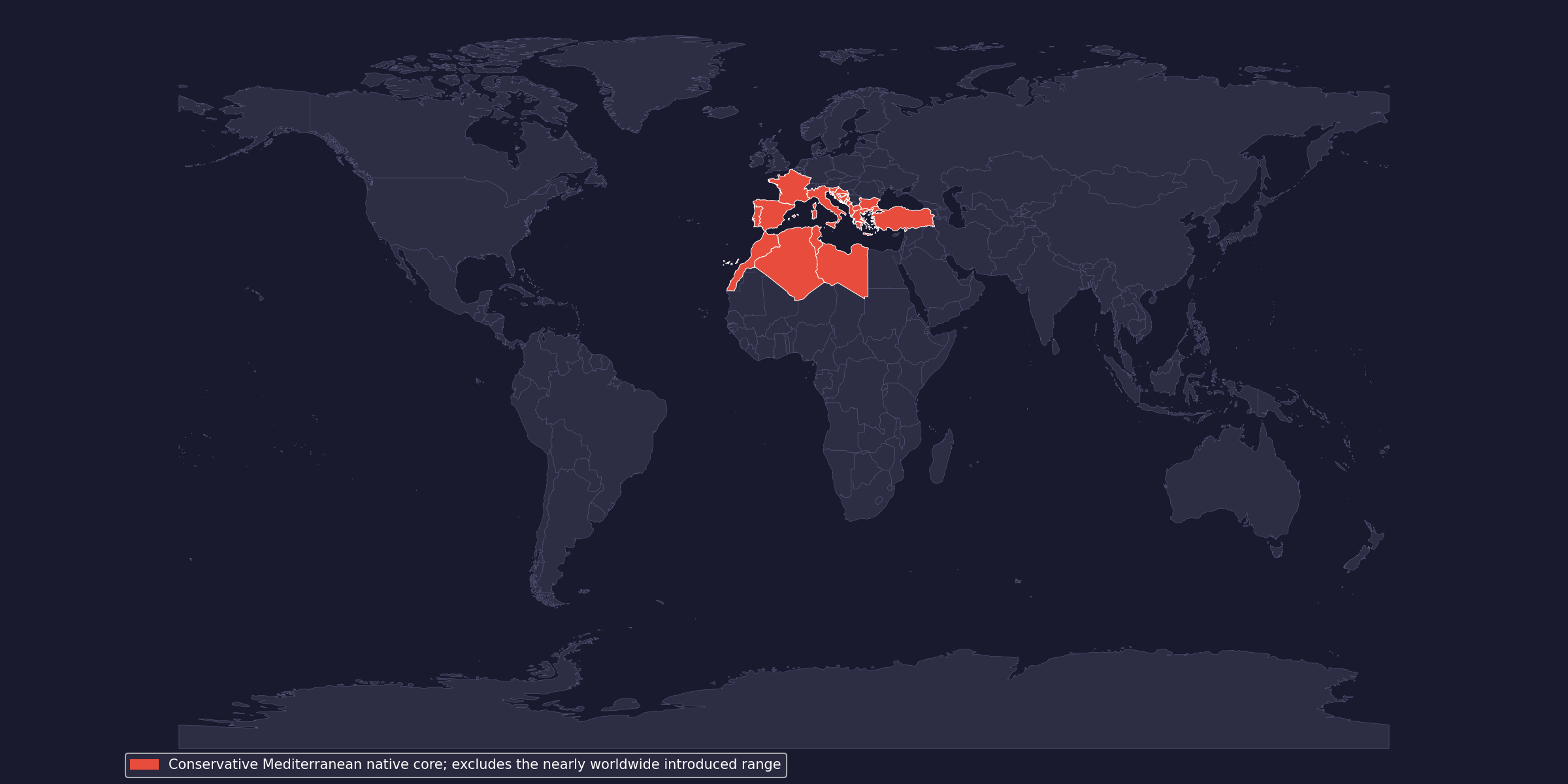
The probable native area lies around the Mediterranean, but centuries of transport with soil, plants and produce have made the species nearly cosmopolitan in suitable temperate habitats. It occurs beneath stones and wood, in litter, gardens, grasslands and disturbed sites. The map shows a conservative Mediterranean native core, not the vast introduced range.
For keeper practice, biosecurity matters more than a precise range map: commercial feeder and cleanup-culture invertebrates are moved far outside their natural ranges, and escaped animals should never be released or treated as harmless.
⚖️ Regulations and safety
Checked on 2026-08-23: Armadillidium vulgare is not listed in the CITES Appendices, Annexes A-D of Commission Regulation (EU) 2026/1383, or Appendices II-III of the Bern Convention.
The EU Invasive Alien Species Regulation restricts species on the Union list; this guide does not treat Armadillidium vulgare as a Union-list species. Local and national rules can still restrict live invertebrate imports, transport, breeding, sale, use in schools or workplaces, and disposal.
Absence from those lists does not override national biosecurity, collection, import, sale or tenancy rules. Retain the invoice, breeder details and morph label, keep cultures secure, never release animals or substrate, and freeze surplus or unwanted invertebrates before disposal where local rules allow.
🤌 Husbandry
A productive isopod culture needs a moisture gradient, leaf litter, decayed wood, calcium, hides, and ventilation. Keep one side damp and one side less wet; stagnant wet substrate is a faster problem than a slightly dry surface layer.
For a display or breeding colony, use at least a 30 x 20 cm footprint with 5-8 cm of leaf-rich substrate. Quarantine new stock for 60 days with separate tools. Inspect it for predatory mites, flies and foreign isopods before combining colonies, and work over a catch tub because mancae pass through very small gaps.
Good setup:
- Smooth-sided plastic tub or ventilated culture box
- Fine mesh or fabric ventilation sized for the feeder
- Dry food or base medium separated from wet food where possible
- Sorting container for feeding and cleaning
- Clear date labels for cultures and purchased batches
💡 Lighting
Feeder invertebrates do not need UVB. A normal room day-night rhythm is enough. Keep cultures out of direct sun because small containers overheat quickly.
🌡 Heating and temperature
Recommended ranges:
- Culture range: 18-24°C
- Tolerates cooler room temperatures
- Avoid sustained heat above 28°C
- Keep one side moist and one side drier
💧 Humidity and water
Keep roughly one-third of the substrate consistently moist and the opposite surface mostly dry. Pour water into the moist corner when its lower layer begins to lighten rather than misting the entire box on a schedule. A water dish is unnecessary and can trap mancae. Condensation over the whole lid, sour soil or animals massing at the vents indicate excess water or inadequate airflow.
🌿 Enclosure and decoration
Use pesticide-free topsoil mixed with crushed hardwood leaves and soft, well-decayed hardwood. Cover most of the surface with safe deciduous leaf litter and place cork across the moisture boundary so animals can shelter at either end. Keep cuttlebone, limestone or baked crushed eggshell available. Avoid fertilized soil, resinous conifer litter, aromatic wood and material collected from treated ground.
Use enough surface area and cross-ventilation to prevent crowding, condensation and odor. Keep cultures simple enough that dead animals, spoiled food and mites can be spotted quickly. Clean small holding tubs between batches and refresh long-term cultures before they collapse.
🪳 Feeding
Useful foods:
- Leaf litter and decayed hardwood
- Vegetable scraps in small portions
- Cuttlefish bone, limestone, or calcium powder source
Feed the culture mainly with leaf litter and decayed hardwood, then add small pieces of vegetables and a constant calcium source. If animals will be used as feeders, harvest from a clean, pesticide-free culture rather than trying to gut-load them at the last minute.
🥚 Breeding
The repository’s broad metadata category records reproduction as “viviparous,” but the exact biology is marsupial brooding. The female transfers eggs to a fluid-filled ventral marsupium, embryos develop there, and the young emerge as mancae. There are no eggs to incubate separately. Stable moisture, leaf litter and calcium support steady colony growth, while stagnant wet substrate causes losses.
Do not let breeding goals override feeder quality. Cultures that smell sour, contain many dead animals, or show heavy mites should not be used for sensitive animals.
🩺 Common problems
Common problems:
- Mold from excess moisture or stale food
- Mites from damp waste and old cultures
- Escape through poor lids or oversized ventilation mesh
- Nutritional imbalance when one feeder is used alone
- Predator injury or impaction risk when feeders are oversized
- Culture crashes from heat, crowding, pesticides, or contamination
📌 Conclusion
This species is most useful as a cleanup animal and occasional feeder when the colony is clean, calcium-rich, and not overharvested. The common failure is a sealed, wet box with too much fresh food and too little ventilation.
The same moisture gradient and deep leaf reserve make it a rewarding display colony. Keep Red stock isolated from wild-type or unverified cultures if line consistency matters, and correct the label rather than selecting animals by colour alone.
📚 Sources and further reading
- GBIF taxonomy: Armadillidium vulgare
- World List of Isopoda (WoRMS): current nomenclature
- Animal Diversity Web: natural history and reproduction
- EAZA Management Guideline Manual for Invertebrate Live Food Species
- Kight 2008: reproductive ecology of terrestrial isopods
- ReptiFiles — checked; no species-specific care guide was found
- CITES Appendices, valid from 5 March 2026
- Commission Regulation (EU) 2026/1383
- Bern Convention appendices
- European Commission: invasive alien species
💬 Feedback
For questions, corrections, or practical notes, leave us a message in the forum thread.