Share

Australian Water Dragon
🔤 Taxonomy
Intellagama lesueurii is an Australian agamid, formerly placed in Physignathus. It includes the eastern and Gippsland forms, I. l. lesueurii and I. l. howittii. It is not the Chinese water dragon, Physignathus cocincinus; keep identity and locality records with the animal.
📌 Description
This large, long-tailed lizard combines climbing, basking and swimming. Adults commonly reach 60–100 cm including the tail, with males generally larger. A 15–20-year commitment is realistic and some live longer. Strong claws and defensive bites make routine restraint unsuitable despite individuals becoming accustomed to people.
| Parameter | Practical reference |
|---|---|
| Adult size | 60–100 cm |
| Lifespan (years) | 15–20 |
| Enclosure (L × W × H) | 300 × 200 × 180 cm |
| Basking surface | 35–40 °C |
| Cool zone | 22–26 °C |
| Night | 18–24 °C |
| Humidity | 50–70% |
🌍 Distribution
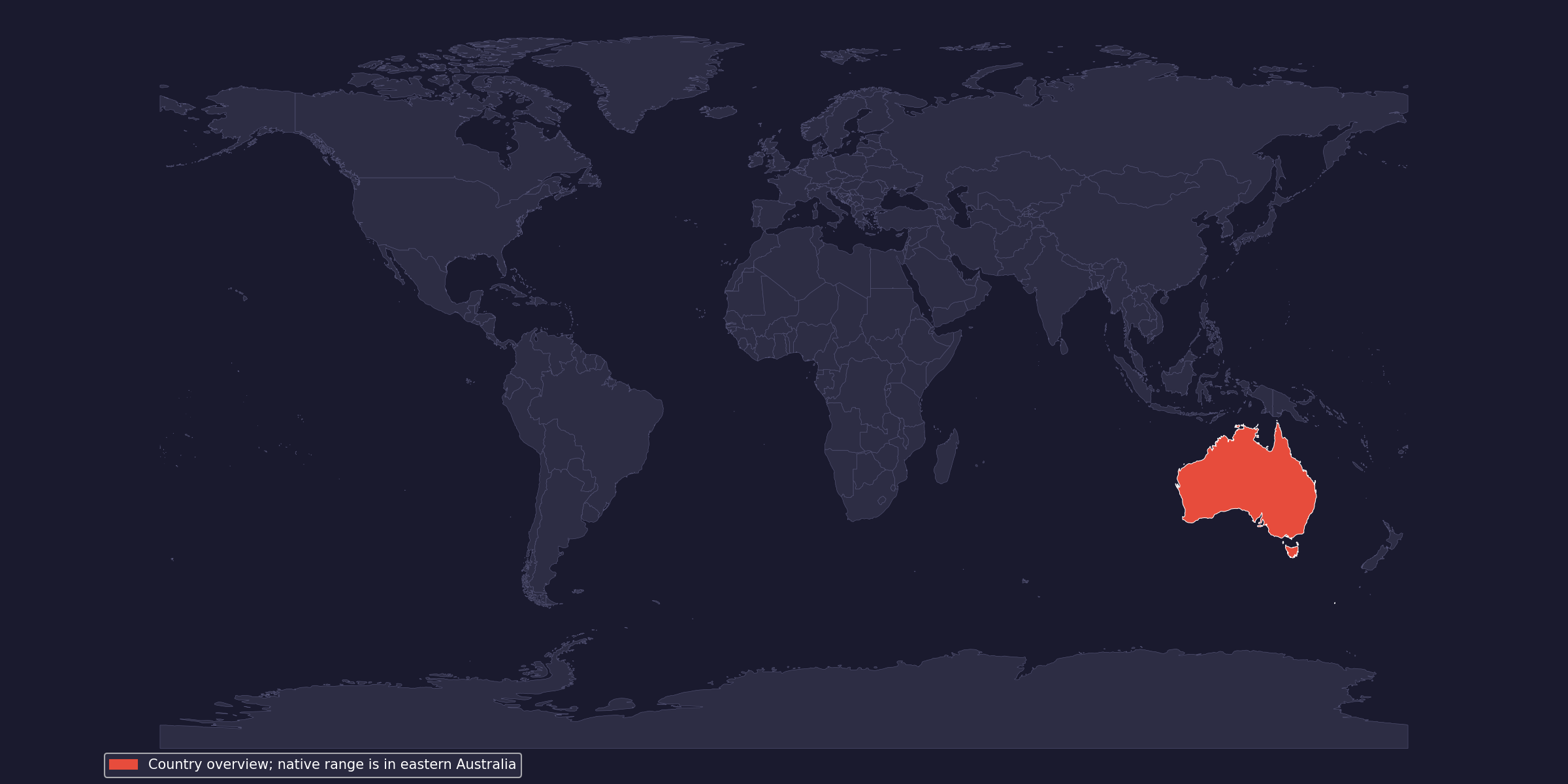
The native range follows eastern Australia, with different populations experiencing subtropical or temperate seasons. Rivers, creeks and wooded banks provide basking sites and escape water. The map marks Australia only; the Brisbane climate example represents the northern part of this climatic variation.
🌡 Climate across the native range
Regional outdoor climate at a representative locality. These air-temperature averages are habitat context, not enclosure settings or temperatures inside shelters.
Brisbane, eastern Australia
| Month | Min °C | Mean °C | Max °C | RH % |
|---|---|---|---|---|
| January | 21.4 | 24.6 | 28.9 | 75 |
| February | 21.2 | 24.2 | 28.3 | 77 |
| March | 19.8 | 23 | 27.2 | 77 |
| April | 16.9 | 20.6 | 25.1 | 76 |
| May | 13.8 | 17.7 | 22.5 | 75 |
| June | 11.4 | 15.4 | 20.2 | 74 |
| July | 10.2 | 14.7 | 20.1 | 71 |
| August | 10.9 | 15.8 | 21.6 | 67 |
| September | 13.6 | 18.5 | 24.3 | 68 |
| October | 16.2 | 20.5 | 25.9 | 70 |
| November | 18.4 | 22.3 | 27.4 | 72 |
| December | 20.1 | 23.7 | 28.5 | 73 |
Weather data by Open-Meteo.com · CC BY 4.0 · Monthly normals calculated by Herpeton Academy from daily archive values.
⚖️ Legal status
Checked on 2026-09-17: Intellagama spp. is listed in CITES Appendix III at Australia’s request and EU Annex C. International movements may require an export permit, certificate of origin or re-export certificate, depending on the route and origin. Obtain advice from the relevant CITES authority before shipping and keep dated acquisition and breeding records. Bern is not relevant to the native range; national keeping rules still apply.
🤌 Husbandry
Plan a room-sized enclosure: approximately 300 × 200 × 180 cm for an adult, with larger accommodation where possible. The ACT Herpetological Association recommends a 3 × 2 m adult footprint. Keep one animal unless equipped to manage a substantially larger compatible group; never combine adult males. Quarantine new arrivals and weigh them regularly. Use a simple, easily inspected quarantine setup for about 90 days, adjusted with veterinary advice; record food intake, weight and faeces, and arrange faecal testing when indicated.
💡 Lighting
Provide bright light, linear UVB and a 10–12-hour active-season day. The basking branch must receive both heat and UVB, while shaded branches permit withdrawal. Select and measure a suitable partial-sun UV gradient with a reptile lighting specialist; bulb percentage and advertised distance alone do not establish exposure. Prevent access to hot fixtures.
🌡 Heating and temperature
Provide a 35–40 °C basking surface, cool air around 22–26 °C and ordinary nights around 18–24 °C. These are active-season enclosure targets, not winter weather limits. Control heating with a thermostat and verify several heights with independent probes and an infrared thermometer. Never make the swimming area the only escape from excess heat.
💧 Humidity and water
Aim for moderate ambient humidity around 50–70%, with ventilation and dry resting sites. Provide a pool allowing full submersion, turning and swimming, with broad easy exits. Remove faeces promptly and change unfiltered water daily; filtration does not remove the need for cleaning and water checks. Avoid stagnant, permanently saturated air.
🌿 Enclosure and decoration
Anchor stout branches and shelves to support the adult’s weight. Include shaded hides, visual barriers and a dry land area alongside the pool. A soil-based substrate around 10–15 cm deep permits digging; laying females need a deeper separate nest area. Seal wet-zone construction and guard drains, filters and electrical cables.
🪳 Feeding
Offer varied gut-loaded insects and suitable earthworms, alongside chopped leafy greens and vegetables. Juveniles need insect meals daily; feed adults measured animal-food portions every 2–3 days and offer fresh greens daily. Adjust to weight and activity, removing spoiled food. Dust prey with calcium and use reptile vitamins according to label and UVB provision. Fruit is occasional; fatty mammals, processed meat and dog or cat food are not routine staples. Choose prey no wider than the space between the eyes; offer smaller items if swallowing looks difficult. With effective measured UVB, use plain calcium for routine dusting and obtain D3 from a coordinated, label-directed vitamin plan; without effective UVB, dietary D3 needs deliberate provision. Do not stack D3 products.
🥚 Breeding
Mature females may lay eggs without a male and need a secluded, diggable nest. Repeated clutches and aggressive courtship can exhaust females. Seasonal cooling varies with origin: only healthy, well-conditioned adults should enter a planned rest after veterinary assessment. Do not refrigerate juveniles or abruptly stop heat and food; this guide is not a brumation schedule.
💤 Seasonal rest
Only consider planned seasonal cooling for healthy, established adults after veterinary advice. Do not cool juveniles, new arrivals, thin or ill animals. Check weight, hydration, parasite status and equipment first; monitor weight, behaviour and temperatures throughout and stop for veterinary review if condition declines.
🩺 Common problems
Inspect the snout, feet and tail for injuries; screen reflection and inadequate cover can drive repeated escape attempts. Wheezing, swollen jaws, weakness, weight loss or prolonged unsuccessful digging require reptile-veterinary assessment. Use calm container transfers where practical, and support the body rather than holding the tail. Weak jaws and poor grip can indicate metabolic bone disease; repeated straining or abdominal swelling may indicate obstruction or egg binding. These require veterinary diagnosis, not extra supplements or home extraction.
📌 Conclusion
The limiting resources are adult space, usable climbing structures and clean swimming water. Compare the Chinese water dragon only with attention to the different species, climate and legal listing.
📚 Sources and further reading
- ACT Herpetological Association — Eastern water dragon husbandry
- Australian Museum — water dragon natural history
- Bebesaurus — firsthand husbandry and breeding
- Reptile Centre — Australian water dragon care
- Baines et al. (2016) — UV-Tool
- GBIF — Intellagama lesueurii
- CITES — official appendices, government publication (2026)
- EU — Regulation 338/97, consolidated 2026-06-29
- Bern Convention — appendices